Skip to content
WAnimals
  • Map
  • Species
  • Parks
  • Diving
Log inCreate account
WAnimals

The guide for travellers and animal lovers: discover, plan and share your wild adventures around the world.

Discover wildlife

  • Species
  • Ecosystems
  • Glossary
  • Tags

Explore places

  • Map
  • Countries
  • Parks
  • Diving

Plan experiences

  • Guides

Learn

  • Blog

Resources

  • Help centre
  • Contact
  • Install the app

Follow us

Account

  • Log in
  • Create account

© 2026 WAnimals. All rights reserved.

About usHow we build our profilesTerms of servicePrivacyLegal notice
MapSpeciesParksDiving
  1. Home
  2. Species
  3. European Mole

One of the 5 moles on WAnimals
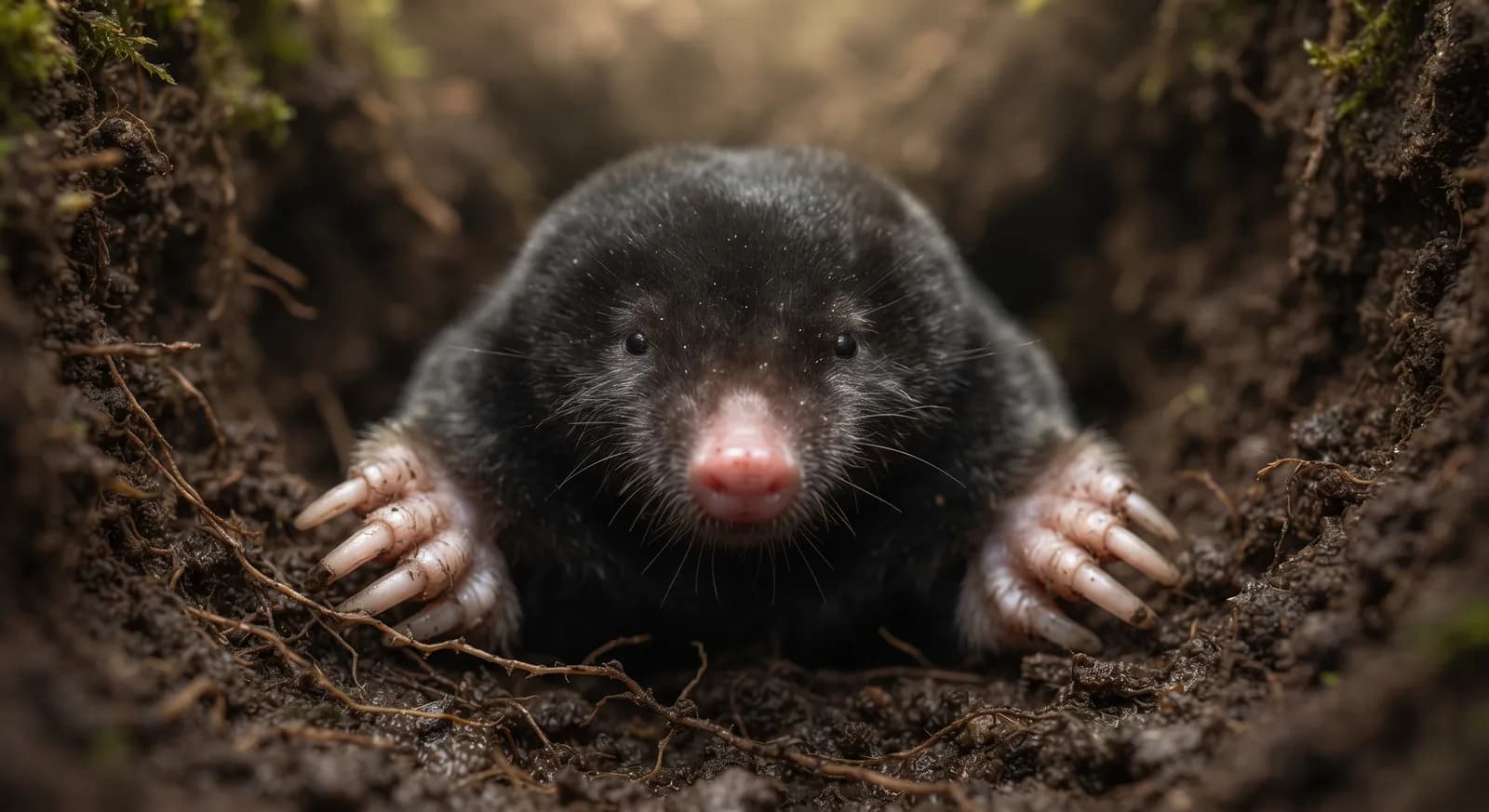
European Mole (Talpa europaea)

Mammals · Eulipotyphla · Talpidae

European Mole

Talpa europaea

Least Concern

The species is abundant and widely distributed; it faces no significant short-term risk.

Spotted something wrong?

Its saliva contains a paralysing toxin that immobilises earthworms, letting it store them alive but helpless in underground larders.

Weight

70 g – 130 g

Size

11 cm – 16 cm

Life expectancy

4 years

Diet

Carnivore

Feeds mainly on other animals.

Activity

Irregular activity

Active at irregular times, by day or night depending on circumstances.

Social structure

Solitary

Lives and hunts alone, joining others only to breed.

Sighting difficulty

Easy

Grassland
45countries168parks4same family

AI-generated images: illustrations, not photographs.

Fun facts

  • Its saliva contains a toxin that immobilises earthworms, letting it store them alive in underground larders.
  • Its tunnels can run for more than 100 metres.
  • It lives almost entirely underground, in damp, soft soil.
  • fisiologíaIt can survive in tunnels with very little oxygen thanks to a special form of haemoglobin that takes up oxygen more efficiently.
  • anatomíaIts hands are extremely broad and turned outwards, shaped specifically for efficient tunnelling, and it can dig several metres of new tunnel in a single night.

Life cycle and biology

Skeleton type
Vertebrate - internal bony skeleton (mammal)
Habitat and environment
Deep soils of farmland, deciduous woodland and permanent pasture across temperate Europe
Birth weight
Born blind and hairless
Size at birth
Born blind and hairless
Sexual maturity
1 year (the spring after birth)
Gestation / incubation
4-5 weeks
Litter / clutch size
2 to 7 young per litter, with a single litter a year

Sources consulted: Wildlife Online; Creature Atlas; Animal Diversity Web; Animalia.bio; iNaturalist

Where to find it

Best time: All year round; it is almost never seen, but its fresh molehills are very obvious in spring and autumn, when it digs most.

Loading map…

Where to see it

Parks and dive sites where this species has been documented — showing 10 of 168.

Related species

Other species in the catalogue with the most in common with European Mole — same habitat, park, country, tags or family.

Same taxonomic family
Shares a park
Shares a park
Shares a park
Shares a park
Shares a park

Keep exploring

Based on what we already know about european mole.

Comments

Share an experience, a fun fact or a tip for seeing the european mole.

Be the first to comment.

See full glossary
This page in other languages: Español · Deutsch · Français · Português · Italiano

The pins mark the parks where its presence is documented.

See its range on the interactive map→
Lake DistrictUnited Kingdom
Swiss National ParkSwitzerland
Gran ParadisoItaly
VanoiseFrance
Hohe TauernAustria
BerchtesgadenGermany
Stelvio (Stilfserjoch)Italy
EcrinsFrance
MercantourFrance
TriglavSlovenia
See all 168 parks
Iberian DesmanVulnerable

Iberian Desman

Galemys pyrenaicus

Least Concern

Eurasian Common Shrew

Sorex araneus

Least Concern

Greater White-toothed Shrew

Crocidura russula

Least Concern

Least Weasel

Mustela nivalis

Pygmy White-toothed ShrewLeast Concern

Pygmy White-toothed Shrew

Suncus etruscus

European HareLeast Concern

European Hare

Lepus europaeus

CountriesPoland
ParksLake DistrictUnited Kingdom
TagsCarnivore
Carnivore
Variable activity
Solitary
Grassland
Mammal

Europe40

Asia5

Poland
Spain
Italy
Romania
Germany
Slovakia
Albania
Andorra
Austria
Belarus
Belgium
Bosnia and Herzegovina
Bulgaria
Croatia
Czechia
Denmark
Estonia
Finland
France
Germany
Greece
Hungary
Ireland
Italy
Kosovo
Latvia
Liechtenstein
Lithuania
Luxembourg
Moldova
Montenegro
Netherlands
North Macedonia
Norway
Poland
Portugal
Romania
San Marino
Serbia
Slovakia
Slovenia
Spain
Sweden
Switzerland
Ukraine
United Kingdom
Armenia
Azerbaijan
Georgia
Russia
Türkiye