Skip to content
WAnimals
  • Map
  • Species
  • Parks
  • Diving
Log inCreate account
WAnimals

The guide for travellers and animal lovers: discover, plan and share your wild adventures around the world.

Discover wildlife

  • Species
  • Ecosystems
  • Glossary
  • Tags

Explore places

  • Map
  • Countries
  • Parks
  • Diving

Plan experiences

  • Guides

Learn

  • Blog

Resources

  • Help centre
  • Contact
  • Install the app

Follow us

Account

  • Log in
  • Create account

© 2026 WAnimals. All rights reserved.

About usHow we build our profilesTerms of servicePrivacyLegal notice
MapSpeciesParksDiving
  1. Home
  2. Species
  3. Firecrest

One of the 2 kinglets on WAnimals

Firecrest (Regulus ignicapilla)

Birds · Passeriformes · Regulidae

Firecrest

Regulus ignicapilla

Least Concern

The species is abundant and widely distributed; it faces no significant short-term risk.

Spotted something wrong?

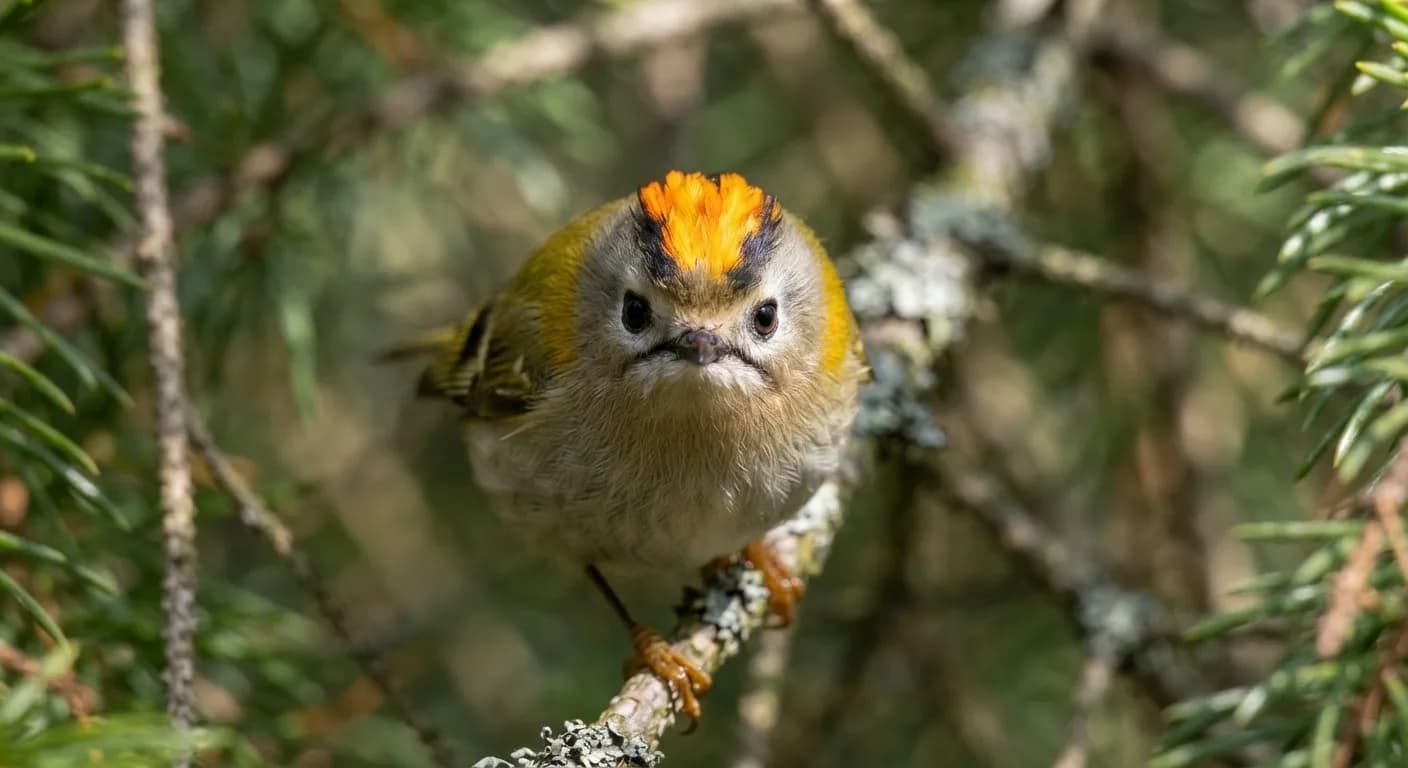
One of the smallest birds in Europe, plump in appearance with a bright green back that contrasts with the dark wings and two whitish bars. Its diagnostic feature is the head pattern: an orange crown in the male and yellow in the female, framed in black, with a white eyebrow and a black eye stripe.

Weight

5 g – 8 g

Size

9 cm – 10 cm

Life expectancy

3 years
Diet

Insectivore

Feeds mainly on insects and other invertebrates.

Activity

Diurnal

Active mainly during the day.

Social structure

In pairs

Usually lives in pairs, sometimes for life.

Sighting difficulty

Easy

Temperate forest
46countries225parks1same family

AI-generated images: illustrations, not photographs.

Fun facts

  • GeneralOne of the smallest birds in Europe, at 5 grams, with a white stripe over the eye.
  • It weighs five grams: a quarter as much as a sparrow, and half its length.
  • Its calls are so high-pitched that many people stop hearing them as they get older, which is why the bird goes unnoticed.
  • It takes the small invertebrates trapped in spiders' webs, and there are reports of firecrests that end up tangled in them.

Life cycle and biology

Skeleton type
Vertebrate - internal bony skeleton (bird)
Habitat and environment
Pine and fir woods and mixed forest
Gestation / incubation
14-16 days, by the female alone. The chicks fledge at three weeks
Litter / clutch size
7-12 tiny white or cream eggs with variable speckling, in a spherical, semi-domed nest of moss and lichen; it may have two clutches

Sources consulted: SEO/BirdLife (ficha y III Atlas de las aves en época de reproducción en España); IUCN Red List; Asturnatura; Pérez-Granados y Serrano-Davies 2014, Enciclopedia Virtual de los Vertebrados Españoles (MNCN-CSIC); Martens y Päckert 2006, Handbook of the Birds of the World vol. 11

Where to find it

Best time: All year round; in autumn and winter it joins the mixed tit flocks that move through the wood

Loading map…

Where to see it

Parks and dive sites where this species has been documented — showing 10 of 225.

Related species

Other species in the catalogue with the most in common with Firecrest — same habitat, park, country, tags or family.

Same taxonomic family
Shares a park
Shares a park
Shares a park
Shares a park
Shares a park

Keep exploring

Based on what we already know about firecrest.

Comments

Share an experience, a fun fact or a tip for seeing the firecrest.

Be the first to comment.

See full glossary
This page in other languages: Español · Deutsch · Français · Português · Italiano

The pins mark the parks where its presence is documented.

See its range on the interactive map→
Doñana National ParkSpain
Lake DistrictUnited Kingdom
CairngormsUnited Kingdom
Snowdonia (Eryri)United Kingdom
KillarneyIreland
Gran ParadisoItaly
VanoiseFrance
Hohe TauernAustria
BerchtesgadenGermany
Stelvio (Stilfserjoch)Italy
See all 225 parks
GoldcrestLeast Concern

Goldcrest

Regulus regulus

Least Concern

Eurasian Collared Dove

Streptopelia decaocto

European NightjarLeast Concern

European Nightjar

Caprimulgus europaeus

European Bee-eaterLeast Concern

European Bee-eater

Merops apiaster

Least Concern

European Green Woodpecker

Picus viridis

Common RavenLeast Concern

Common Raven

Corvus corax

CountriesSpain
ParksDoñana National ParkSpain
TagsInsectivore
Insectivore
Diurnal
In pairs
Bird
Temperate forest

Europe40

Asia5

Africa1

Spain
Poland
Italy
United Kingdom
France
Germany
Albania
Andorra
Austria
Belarus
Belgium
Bosnia and Herzegovina
Bulgaria
Croatia
Czechia
Denmark
Estonia
Finland
France
Germany
Greece
Hungary
Ireland
Italy
Kosovo
Latvia
Liechtenstein
Lithuania
Luxembourg
Moldova
Montenegro
Netherlands
North Macedonia
Norway
Poland
Portugal
Romania
San Marino
Serbia
Slovakia
Slovenia
Spain
Sweden
Switzerland
Ukraine
United Kingdom
Armenia
Azerbaijan
Georgia
Russia
Türkiye
Morocco