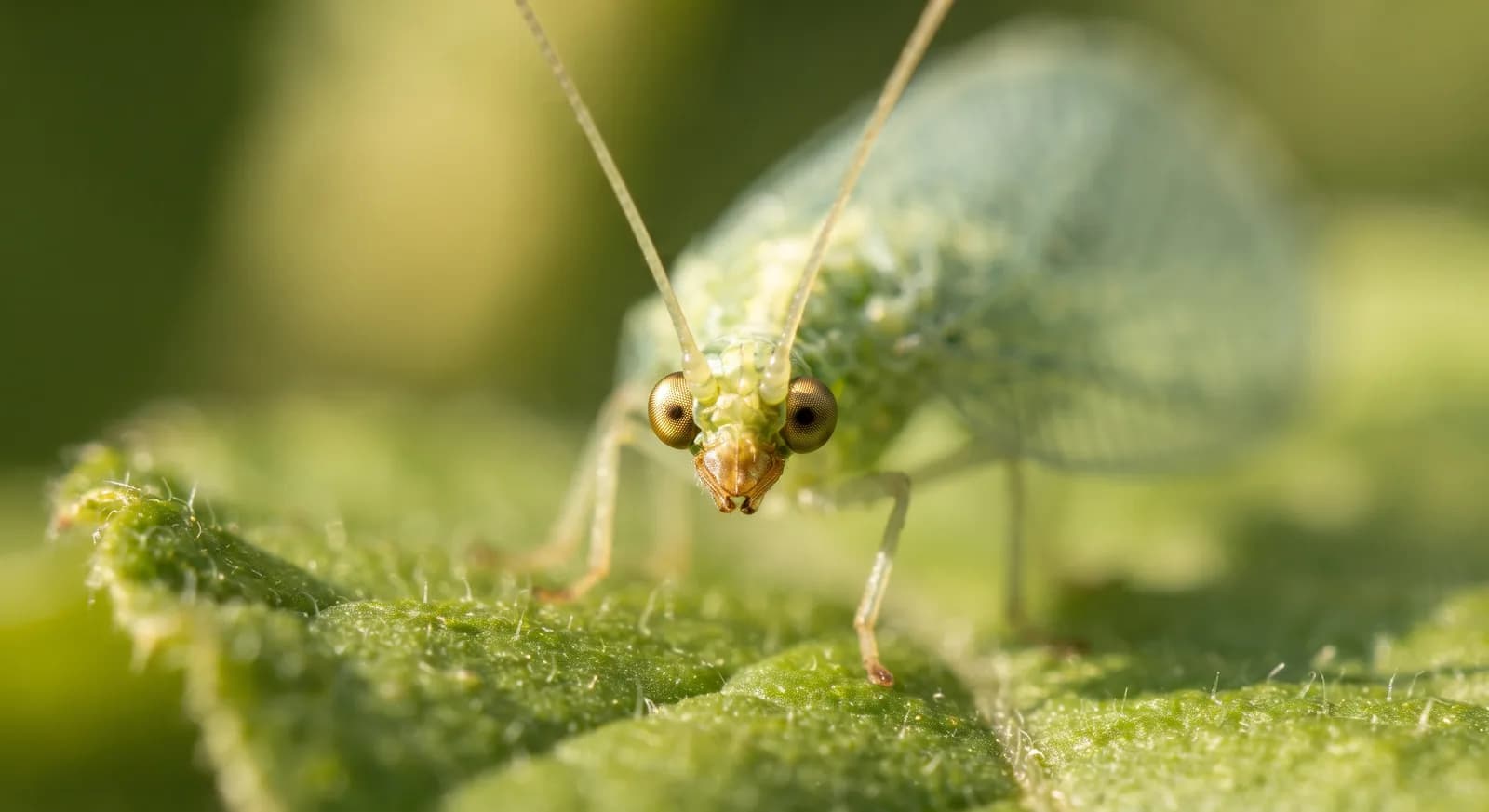
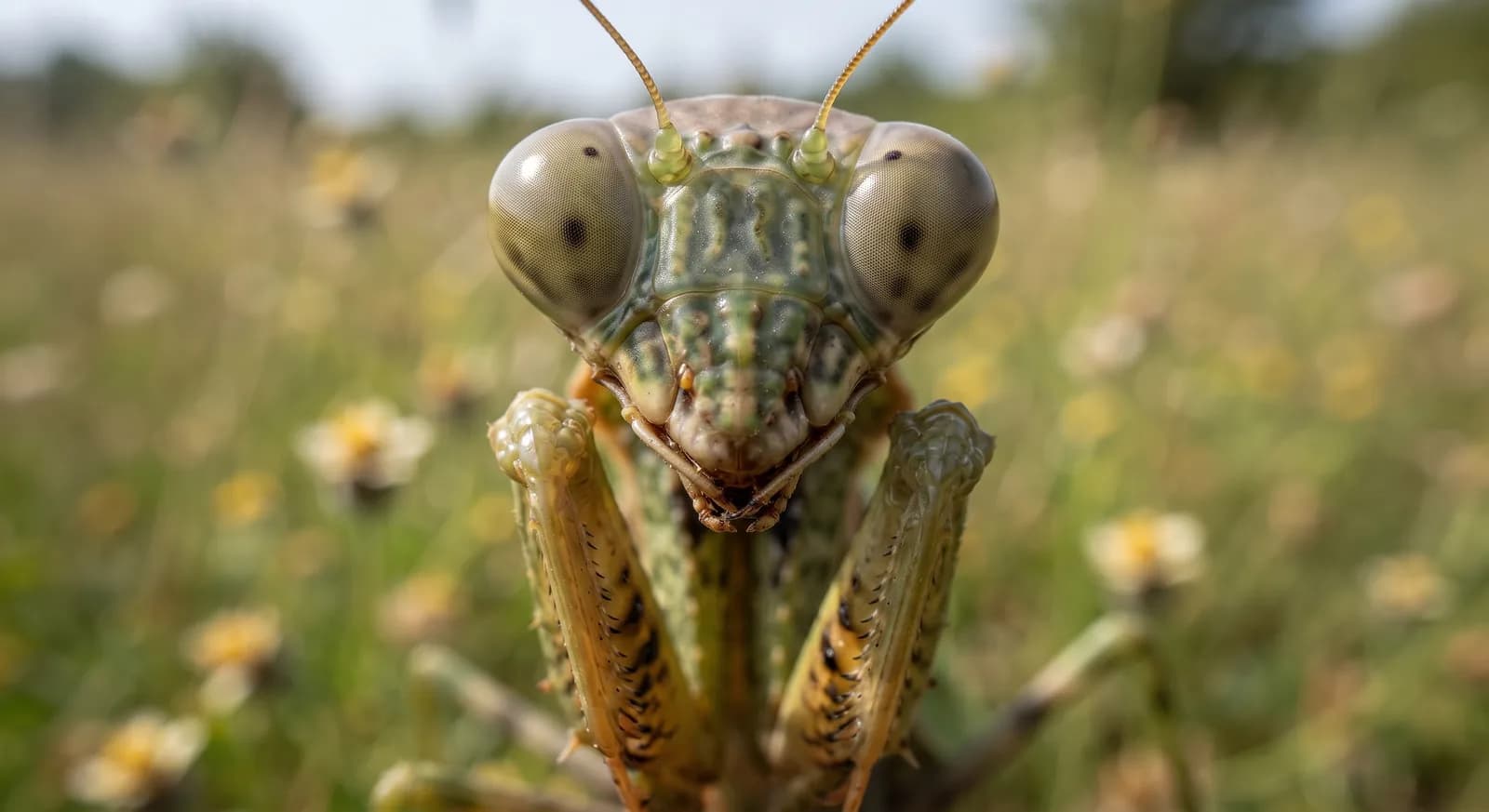
A delicate-looking insect of pale green colour, with a long, narrow abdomen, large golden eyes, thread-like antennae and two pairs of membranous wings with net-like venation that it folds roof-wise over the body. The larva, by contrast, is flattened and carries two curved, pincer-like mandibles.
Size
1.2 cm – 2 cm
Life expectancy
1 year
Diet
Carnivore
Feeds mainly on other animals.
Activity
Nocturnal
Active mainly at night.
Social structure
Solitary
Lives and hunts alone, joining others only to breed.
AI-generated images: illustrations, not photographs.
Fun facts
Only the larva is predatory: the adult feeds on pollen, nectar and the honeydew excreted by aphids.
A single larva can eat between 200 and 400 aphids during its development, and when prey is scarce it turns to cannibalism.
The stalk of the egg exists for precisely that reason: it holds the egg away from the leaf and out of reach of its own newly hatched sisters.
Only the larva is predatory: it is called the aphid lion and pierces its prey with its mandibles to drain it. The adult does not hunt; it eats pollen, nectar and honeydew.
One larva can get through hundreds of aphids, and it also eats whiteflies, spider mites, thrips, lepidopteran eggs and scale insects.
It is sold for biological control, usually as eggs mixed with rice husks for scattering through the crop.
It competes with other aphid predators: in intraguild predation trials the lacewing larva usually beats ladybirds.
What is known as Chrysoperla carnea is in fact a complex of cryptic species told apart by their vibrational courtship song.
Life cycle and biology
Skeleton type
Invertebrate - chitin exoskeleton (insect)
Habitat and environment
Cosmopolitan except in the coldest zones: farmland, urban allotments, gardens and open country, above all where flowering plants are abundant, since the adults feed on nectar and pollen
Size at birth
Pale green oval egg, 0.8 to 1.5 mm, held at the tip of a silk stalk up to 1 cm long
Sexual maturity
The full cycle from egg to adult takes 4 to 6 weeks at 20-28 °C; the eggs hatch in 3-6 days, the larva goes through three instars in 2-3 weeks and the pupa lasts 10 to 14 days inside a silk cocoon
Gestation / incubation
The larvae emerge three to six days after the eggs are laid
Litter / clutch size
About 20 eggs a day, each on the end of a long stalk, laid near aphid colonies
Sources consulted: Koppert; Bioline Iberia; Solagro; Campos (estudios en olivar del sur de España); Medina, Budia, Vogt, Del Estal y Viñuela (controlbiologico.info); Cannabis Magazine (revisión de crisópidos ibéricos); Fichas de biologia de Chrysoperla carnea; Cornell IPM; Purdue University Vegetable Crops Hotline; Cornell IPM, ficha Common Green Lacewing; Grokipedia, recopilacion de Chrysoperla carnea; Minnesota Seasons; Minnesota Seasons, ficha Common Green Lacewing; Texas A&M; Nature Journeys; Recopilacion de biologia de Chrysoperla; Texas A&M, guia de insectos
Where to find it
Best time: From spring to summer, with two or three generations a year. It overwinters as an adult, in diapause: the individuals of the last generation turn straw-coloured or reddish brown and gather in the leaf litter and in dry, dark corners
Loading map…
Where to see it
Parks and dive sites where this species has been documented — showing 10 of 152.
Related species
Other species in the catalogue with the most in common with Common Green Lacewing — same habitat, park, country, tags or family.
Shares a park
Shares a park
Shares a park
Shares a park
Shares a park
Shares a park
Keep exploring
Based on what we already know about common green lacewing.
Comments
Share an experience, a fun fact or a tip for seeing the common green lacewing.