Skip to content
WAnimals
  • Map
  • Species
  • Parks
  • Diving
Log inCreate account
WAnimals

The guide for travellers and animal lovers: discover, plan and share your wild adventures around the world.

Discover wildlife

  • Species
  • Ecosystems
  • Glossary
  • Tags

Explore places

  • Map
  • Countries
  • Parks
  • Diving

Plan experiences

  • Guides

Learn

  • Blog

Resources

  • About us
  • How we build our profiles
  • Help centre
  • Contact
  • Install the app

Follow us

Account

  • Log in
  • Create account

© 2026 WAnimals. All rights reserved.

Terms of servicePrivacyCookiesLegal notice
MapSpeciesParksDiving
  1. Home
  2. Species
  3. Common Millipede

One of the 4 millipedes on WAnimals
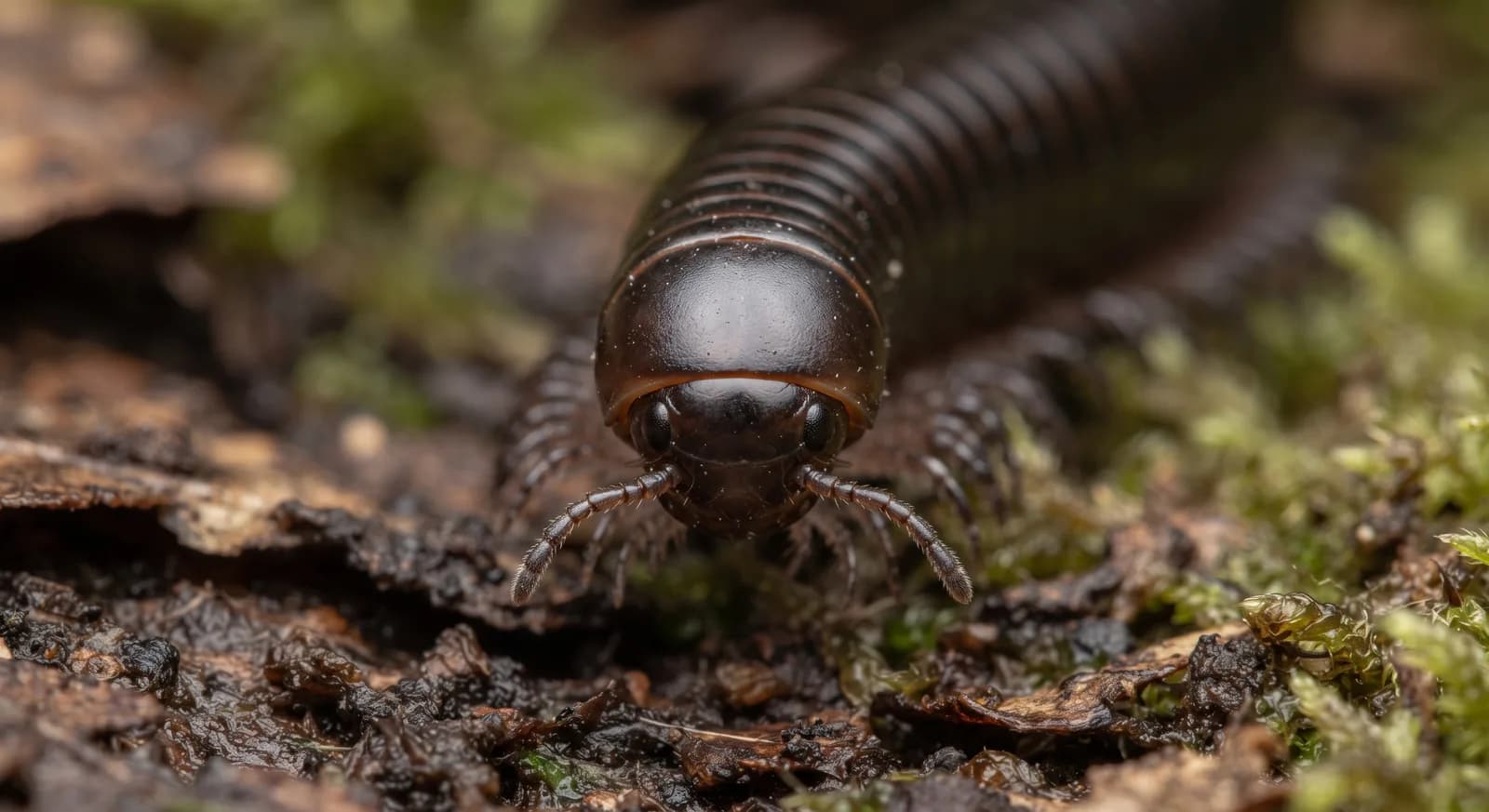
Common Millipede (Julus terrestris)

Millipedes · Julida · Julidae

Common Millipede

Julus terrestris

Not Evaluated

It has not yet been assessed against the IUCN criteria.

Spotted something wrong?

A millipede with a cylindrical grey body and clearly marked rings, very short antennae and two pairs of legs per segment from the seventh onwards. It has between 45 and 55 rings and between 72 and 102 pairs of legs. It hatches with only seven rings and adds more throughout its life.

Size

5 cm on average

Diet

Detritivore

Feeds on dead organic matter as it decomposes.

Activity

Nocturnal
Active mainly at night.

Social structure

Solitary

Lives and hunts alone, joining others only to breed.

Temperate forest
45countries152parks

AI-generated images: illustrations, not photographs.

Fun facts

  • Despite the name, it never reaches a thousand legs: an individual with 52 segments has 194.
  • With so many legs it needs fine coordination not to trip itself up: it moves them in a wave, so that only one foot in eight is touching the ground at any moment.
  • Unlike centipedes, it is entirely harmless: a herbivore and decomposer, it works organic matter into the soil and is worth encouraging rather than killing.
  • It does not have a thousand legs: millipedes carry two pairs per segment, and common species have around a hundred or two hundred. The group record is held by an Australian species with 1,306.
  • It defends itself by coiling into a spiral and secreting repellent substances through pores along its sides; some millipedes produce compounds that release cyanide.
  • It walks with an undulating leg movement that travels along the body like a wave, a mechanism that has been copied in robotics.
  • It is a detritivore and essential to the recycling of forest soil: it breaks up leaf litter and leaves it ready for fungi and bacteria.
  • Unlike centipedes, which are fast, venomous predators, millipedes are slow, harmless and vegetarian.

Life cycle and biology

Skeleton type
Invertebrate - chitin exoskeleton (myriapod)
Habitat and environment
Damp soils with organic matter: woodland, allotments, cultivated plots and gardens

Sources consulted: Fauna Europaea · Wikipedia (Julus terrestris) · Naturaleza Para Todos · Fauna Auxiliar (Familia Julidae) · Alma Biológica

Where to find it

Best time: Autumn and spring, on damp days, under stones and leaf litter

Loading map…

Where to see it

Parks and dive sites where this species has been documented — showing 10 of 152.

Related species

Other species in the catalogue with the most in common with Common Millipede — same habitat, park, country, tags or family.

Shares a park
Shares a park
Shares a park
Shares a park
Shares a park
Shares a park

Keep exploring

Based on what we already know about common millipede.

Share an experience, a fun fact or a tip for seeing the common millipede.
See full glossary
This page in other languages: Español · Deutsch · Français · Português · Italiano

The pins mark the parks where its presence is documented.

See its range on the interactive map→
Lake DistrictUnited Kingdom
CairngormsUnited Kingdom
Snowdonia (Eryri)United Kingdom
KillarneyIreland
Picos de EuropaSpain
Ordesa y Monte PerdidoSpain
Aiguestortes i Estany de Sant MauriciSpain
Peneda-GeresPortugal
Abruzzo, Lazio and MoliseItaly
Alta MurgiaItaly
See all 152 parks
Not Evaluated

Megarian Banded Centipede

Scolopendra cingulata

Common EarthwormNot Evaluated

Common Earthworm

Lumbricus terrestris

Not Evaluated

Pill Millipede

Glomeris marginata

West European HedgehogNear Threatened

West European Hedgehog

Erinaceus europaeus

Fat DormouseLeast Concern

Fat Dormouse

Glis glis

Eurasian LynxLeast Concern

Eurasian Lynx

Lynx lynx

CountriesSpain
ParksLake DistrictUnited Kingdom
TagsNocturnal
Nocturnal
Solitary
Temperate forest
Myriapod
Detritivore

Europe40

Asia5

Spain
Italy
United Kingdom
Poland
Germany
Greece
Albania
Andorra
Austria
Belarus
Belgium
Bosnia and Herzegovina
Bulgaria
Croatia
Czechia
Denmark
Estonia
Finland
France
Germany
Greece
Hungary
Ireland
Italy
Kosovo
Latvia
Liechtenstein
Lithuania
Luxembourg
Moldova
Montenegro
Netherlands
North Macedonia
Norway
Poland
Portugal
Romania
San Marino
Serbia
Slovakia
Slovenia
Spain
Sweden
Switzerland
Ukraine
United Kingdom
Armenia
Azerbaijan
Georgia
Russia
Türkiye