Skip to content
WAnimals
  • Map
  • Species
  • Parks
  • Diving
Log inCreate account
WAnimals

The guide for travellers and animal lovers: discover, plan and share your wild adventures around the world.

Discover wildlife

  • Species
  • Ecosystems
  • Glossary
  • Tags

Explore places

  • Map
  • Countries
  • Parks
  • Diving

Plan experiences

  • Guides

Learn

  • Blog

Resources

  • About us
  • How we build our profiles
  • Help centre
  • Contact
  • Install the app

Follow us

Account

  • Log in
  • Create account

© 2026 WAnimals. All rights reserved.

Terms of servicePrivacyCookiesLegal notice
MapSpeciesParksDiving
  1. Home
  2. Species
  3. Edible Frog

One of the 47 frogs on WAnimals
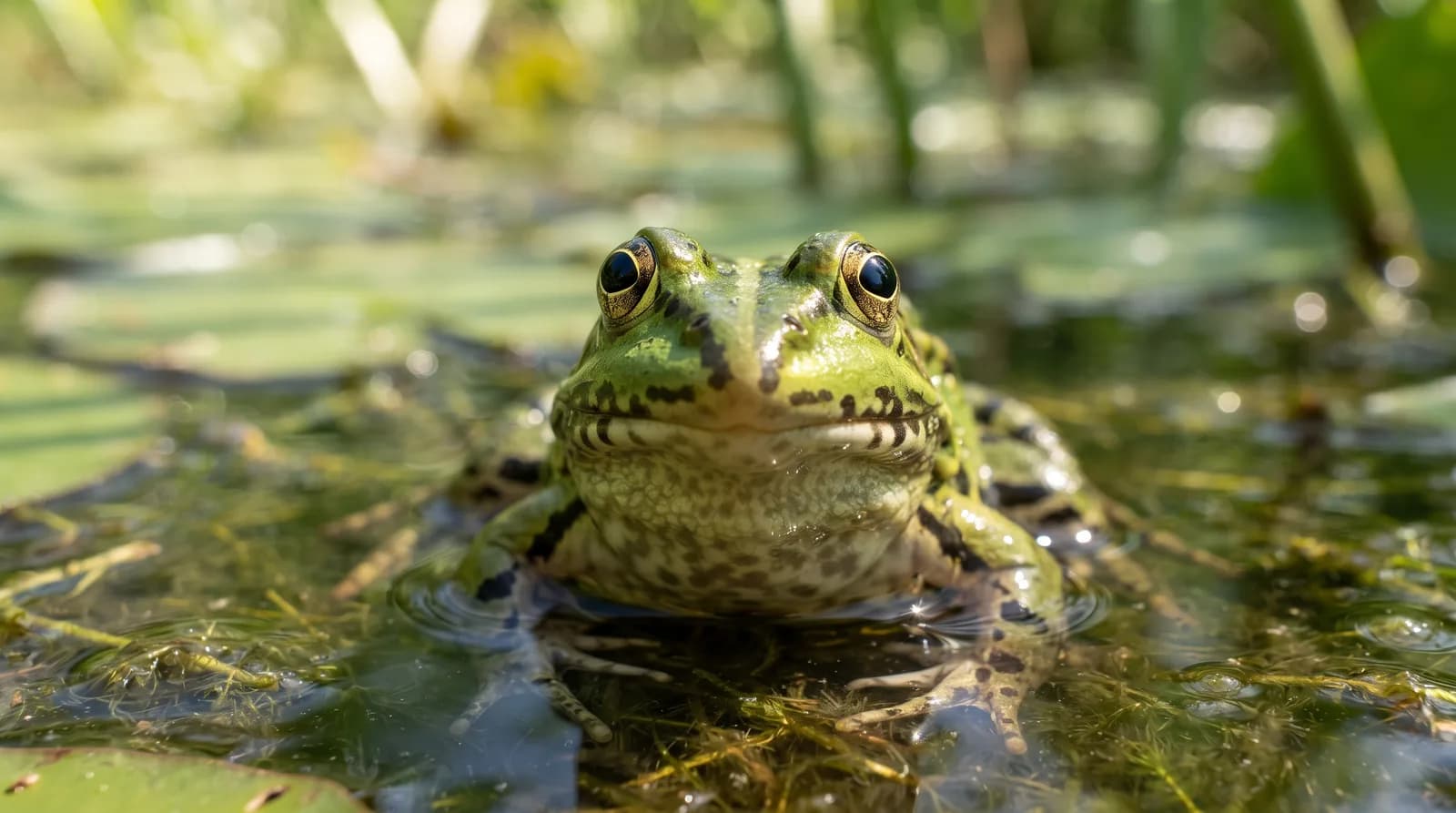
Edible Frog (Pelophylax kl. esculentus)

Amphibians · Anura · Ranidae

Edible Frog

Pelophylax kl. esculentus

Least Concern

The species is abundant and widely distributed; it faces no significant short-term risk.

Spotted something wrong?

A medium-sized green frog, with a broad head, bulging eyes with an oval pupil and a very visible eardrum. The males have lateral vocal sacs. It is not a species in the strict sense but a klepton: a fertile hybrid between the pool frog and the marsh frog.

Size

5 cm – 11 cm

Life expectancy

10 years

Diet

Carnivore

Feeds mainly on other animals.
Activity

Diurnal

Active mainly during the day.

Social structure

Solitary

Lives and hunts alone, joining others only to breed.

Freshwater
48countries41parks11same family

AI-generated images: illustrations, not photographs.

Fun facts

  • GeneralIt is a fertile hybrid between two green frog species, which is rare among vertebrates.
  • It reproduces by hybridogenesis: when its gametes form it discards one of the two parental genomes, so that half its DNA is passed on cloned and intact.
  • Two edible frogs can mate and lay eggs, but the larvae die: it needs to cross with one of the parent species in order to keep going.
  • The name comes from its legs, eaten above all in France, Germany and Italy.
  • It is not a species but a hybrid. It arose from the cross between the pool frog and the marsh frog, and it perpetuates itself by hybridogenesis: it eliminates one of the two parental genomes from its germ cells and passes on only the other.
  • That forces it to live alongside one of the parental species in order to reproduce, which is why it is regarded as a genetic parasite, or klepton. The abbreviation kl. in its name means precisely that.
  • In some Swiss populations the extreme case has been found: populations made up solely of hybrids, which complete the cycle with no parental species present.
  • In western Europe the system has been thrown off balance by the introduction of marsh frogs from other regions, which produce new hybrids, sometimes sterile, and threaten both the pool frog and the klepton itself.
  • It is the frog whose legs are traditionally eaten in France, hence the name of edible frog.

Life cycle and biology

Skeleton type
Vertebrate - internal bony skeleton (amphibian)
Habitat and environment
Ponds, canals and vegetated banks

Sources consulted: IUCN Red List (e.T76317591A87648183) · Amphibian Species of the World (Frost, AMNH) · Dubois 1992, Bulletin de la Société Linnéenne de Lyon 61 · CITES CoP20 Prop. 27 · Wikipedia (Edible frog)

Where to find it

Best time: From spring to summer, when it is most active; in winter it withdraws onto land to hibernate

Loading map…

Where to see it

Parks and dive sites where this species has been documented — showing 10 of 41.

Related species

Other species in the catalogue with the most in common with Edible Frog — same habitat, park, country, tags or family.

Same taxonomic family
Shares a park
Shares a park

Keep exploring

Based on what we already know about edible frog.

Share an experience, a fun fact or a tip for seeing the edible frog.
See full glossary
This page in other languages: Español · Deutsch · Français · Português · Italiano

The pins mark the parks where its presence is documented.

See its range on the interactive map→
BiałowieżaPoland
Danube DeltaRomania
LahemaaEstonia
Hortobágy National ParkHungary
Šumava (Bohemian Forest)Czechia
High Veluwe (Hoge Veluwe)Netherlands
Donau-AuenAustria
Neusiedler See-SeewinkelAustria
EifelGermany
MüritzGermany
See all 41 parks
Least Concern

American Bullfrog

Lithobates catesbeianus

Least Concern

Agile Frog

Rana dalmatina

Common FrogLeast Concern

Common Frog

Rana temporaria

Least Concern

Perez's Frog

Pelophylax perezi

Western Marsh HarrierLeast Concern

Western Marsh Harrier

Circus aeruginosus

Least Concern

Grass Snake

Natrix natrix

CountriesPoland
ParksBiałowieżaPoland
TagsCarnivore
Carnivore
Diurnal
Solitary
Amphibian
Freshwater

Europe43

Asia5

Poland
Hungary
Netherlands
Germany
Estonia
Austria
Albania
Andorra
Austria
Belarus
Belgium
Bosnia and Herzegovina
Bulgaria
Croatia
Cyprus
Czechia
Denmark
Estonia
Finland
France
Germany
Greece
Hungary
Ireland
Italy
Kosovo
Latvia
Liechtenstein
Lithuania
Luxembourg
Malta
Moldova
Montenegro
Netherlands
North Macedonia
Norway
Poland
Portugal
Romania
San Marino
Serbia
Slovakia
Slovenia
Spain
Sweden
Switzerland
Ukraine
United Kingdom
Vatican City
Armenia
Azerbaijan
Georgia
Russia
Türkiye