One of the 4 falcons on WAnimals
Birds · Accipitriformes · Accipitridae
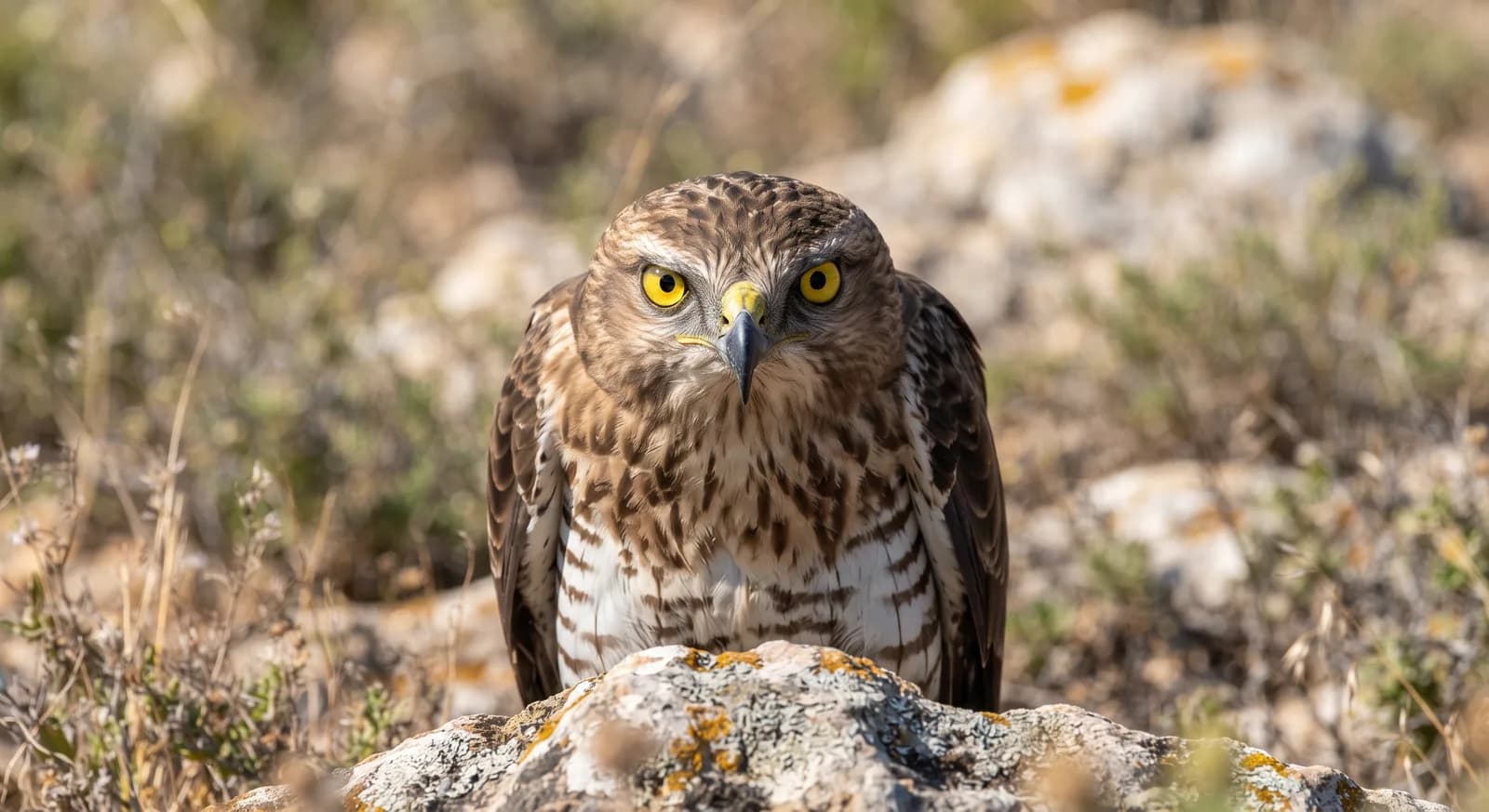
European Honey Buzzard
Pernis apivorus
The species is abundant and widely distributed; it faces no significant short-term risk. See full glossary
The European honey buzzard is a raptor specialised in an unusual food: it digs out the nests of wasps and bumblebees in the ground and eats the grubs and the comb. It has stiff, scale-like feathers on its face that protect it from stings and straight talons adapted to digging rather than gripping. In Spain it is a migrant that breeds in the northern woodlands and crosses the Strait of Gibraltar in spectacular concentrations.
Weight
360 g – 1.1 kg
Size
52 cm – 60 cm
Lifespan
29 years
Diet
Insectivore
Feeds mainly on insects and other invertebrates.
Activity
Nocturnal
Active mainly at night.
Social structure
In pairs
Usually lives in pairs, sometimes for life.
Sighting difficulty
Easy
Fun facts
- GeneralIt digs out wasp and bumblebee nests; the feathers on its face protect it from the stings.
- It digs out wasp nests with its feet and eats the grubs: stiff, scale-like feathers around its eyes and bill protect it from stings, and the wasps appear not to recognise it as a threat.
- It crosses the Strait of Gibraltar in enormous concentrations: within a few days in May and September tens of thousands of honey buzzards may pass, one of the most remarkable migration spectacles in Europe.
- Its plumage mimics the common buzzard's, and the prevailing hypothesis is defensive mimicry: by resembling a more aggressive raptor it suffers fewer attacks from crows and other birds.
Life cycle & biology
- Skeleton type
- Vertebrate - internal bony skeleton (bird)
- Habitat & environment
- Deciduous and mixed woodland with clearings
- Sexual maturity
- 3 years
- Gestation / incubation
- 33 days of incubation
- Litter / clutch size
- 2 eggs
Sources consulted: https://es.wikipedia.org/wiki/Pernis_apivorus
Where to find it
See its range on the interactive mapWhere to watch it
Parques y spots de buceo donde se ha documentado esta especie — se muestran 10 de 206 documentados.
Related species
Other species in the catalogue with the most in common with European Honey Buzzard — same habitat, park, country, tags or family.
Lesser Spotted Eagle
Clanga pomarina
Booted Eagle
Hieraaetus pennatus
Eurasian Sparrowhawk
Accipiter nisus
Northern Goshawk
Accipiter gentilis
 Least Concern
Short-toed Eagle
Circaetus gallicus
Common Buzzard
Buteo buteo
Keep exploring
Based on what we already know about european honey buzzard.
Comments
Share an experience, a fun fact or a tip for seeing the european honey buzzard.
Be the first to comment.