Skip to content
WAnimals
  • Map
  • Species
  • Parks
  • Diving
Log inCreate account
WAnimals

The guide for travellers and animal lovers: discover, plan and share your wild adventures around the world.

Discover wildlife

  • Species
  • Ecosystems
  • Glossary
  • Tags

Explore places

  • Map
  • Countries
  • Parks
  • Diving

Plan experiences

  • Guides

Learn

  • Blog

Resources

  • About us
  • How we build our profiles
  • Help centre
  • Contact
  • Install the app

Follow us

Account

  • Log in
  • Create account

© 2026 WAnimals. All rights reserved.

Terms of servicePrivacyCookiesLegal notice
MapSpeciesParksDiving
  1. Home
  2. Species
  3. Peppered Moth

One of the 15 butterflies on WAnimals
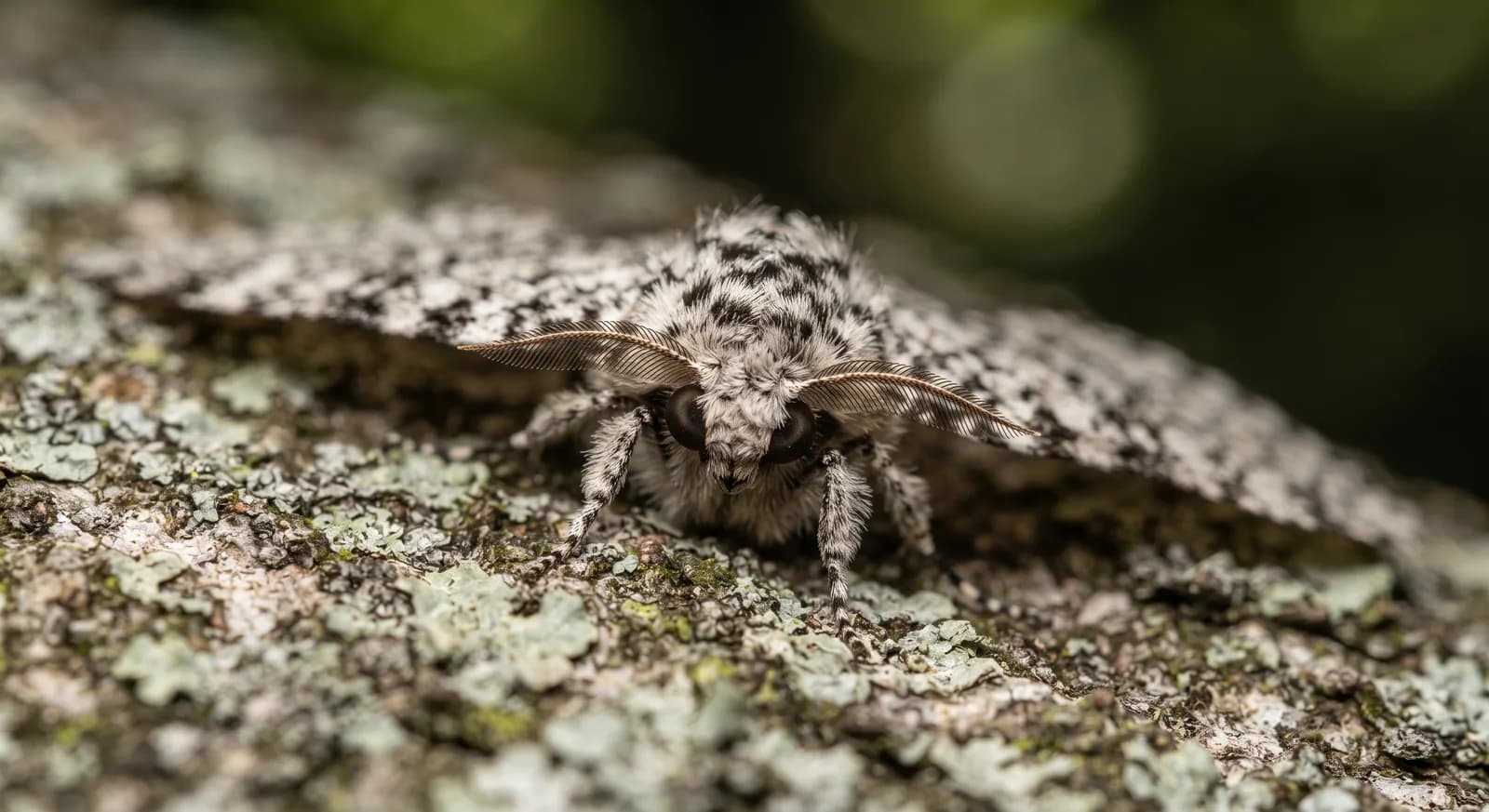
Peppered Moth (Biston betularia)

Insects · Lepidoptera · Geometridae

Peppered Moth

Biston betularia

Not Evaluated

It has not yet been assessed against the IUCN criteria.

Spotted something wrong?

A broad-winged moth with salt-and-pepper mottling over a whitish ground, crossed by fine dark lines, which camouflages it perfectly against lichen-covered bark. There is also an almost entirely black form, the variety carbonaria. The caterpillar, elongated like a twig, mimics the bark of a tree.

Size

6 cm on average

Life expectancy

1 year

Diet

Herbivore

Feeds mainly on plants.
Activity

Nocturnal

Active mainly at night.

Social structure

Solitary

Lives and hunts alone, joining others only to breed.

Temperate forest
46countries139parks

AI-generated images: illustrations, not photographs.

Fun facts

  • It is the most celebrated example of natural selection observed within a human lifetime: industrial melanism ran its course in about 50 generations. The first dark specimen was caught near Manchester in 1848, and by 1898 dark moths already made up 95% of the local population.
  • In 2016 the mutation responsible was identified: a transposable element inserted into a gene, published in Nature.
  • The dark form is in decline today because cleaner air has brought the lichens back to the tree trunks: natural selection working in reverse.
  • It is the most-cited example of natural selection in all the textbooks. During the Industrial Revolution, soot darkened the tree trunks of English woodlands and the black form, called carbonaria, went from exceedingly rare to dominant in polluted areas, because birds spotted it less often.
  • With the clean air laws of the 20th century the process reversed: the lichens returned, the trunks lightened and the pale form regained ground. It is evolution observed in real time, over a century and a half.
  • The genetic cause was identified in 2016: a transposable element, a jumping fragment of DNA, inserted into the first intron of the cortex gene. Statistical analysis places that mutation around 1819, with the Industrial Revolution already under way.
  • The caterpillar mimics a twig, and not only in shape: it adopts the posture of a dry branch and can change colour to match the tone of the one it is sitting on.
  • There is a third form, insularia, with intermediate patterns, genetically distinct from the other two.

Life cycle and biology

Skeleton type
Invertebrate - chitin exoskeleton (insect)
Habitat and environment
Floodplains, wetlands and mixed deciduous woodland and their fringes. It also occurs on cultivated or abandoned farmland and even in densely built-up residential areas
Litter / clutch size
A single, very drawn-out generation a year. The females lay eggs in great numbers and the newly hatched caterpillars disperse by spinning silk threads on which they let the wind carry them

Sources consulted: Kettlewell 1955, Heredity 9(3) · Kettlewell 1973, The Evolution of Melanism · Majerus 2008, Evolution: Education and Outreach 2(1) · Van't Hof et al. 2016, Nature 534 · Walton et al. 2018, Communications Biology 1 · Cook 2003

Where to find it

Best time: From early May to August

Loading map…

Where to see it

Parks and dive sites where this species has been documented — showing 10 of 139.

Related species

Other species in the catalogue with the most in common with Peppered Moth — same habitat, park, country, tags or family.

Shares a park
Shares a park
Shares a park
Shares a park
Shares a park
Shares a park

Keep exploring

Based on what we already know about peppered moth.

Share an experience, a fun fact or a tip for seeing the peppered moth.
See full glossary
This page in other languages: Español · Deutsch · Français · Português · Italiano

The pins mark the parks where its presence is documented.

See its range on the interactive map→
SarekSweden
PadjelantaSweden
HardangerviddaNorway
Lake DistrictUnited Kingdom
CairngormsUnited Kingdom
Snowdonia (Eryri)United Kingdom
KillarneyIreland
Picos de EuropaSpain
Ordesa y Monte PerdidoSpain
Aigüestortes i Estany de Sant MauriciSpain
See all 139 parks
Stag BeetleNear Threatened

Stag Beetle

Lucanus cervus

Vulnerable

Greater Capricorn Beetle

Cerambyx cerdo

Not Evaluated

Ant-lion

Myrmeleon formicarius

European Rhinoceros BeetleNot Evaluated

European Rhinoceros Beetle

Oryctes nasicornis

Not Evaluated

Western Conifer Seed Bug

Leptoglossus occidentalis

Not Evaluated

Pill Millipede

Glomeris marginata

CountriesSpain
ParksSarekSweden
TagsHerbivore
Herbivore
Nocturnal
Solitary
Insect
Temperate forest

Europe40

Asia6

Spain
Sweden
United Kingdom
Finland
Poland
Germany
Albania
Andorra
Austria
Belarus
Belgium
Bosnia and Herzegovina
Bulgaria
Croatia
Czechia
Denmark
Estonia
Finland
France
Germany
Greece
Hungary
Ireland
Italy
Kosovo
Latvia
Liechtenstein
Lithuania
Luxembourg
Moldova
Montenegro
Netherlands
North Macedonia
Norway
Poland
Portugal
Romania
San Marino
Serbia
Slovakia
Slovenia
Spain
Sweden
Switzerland
Ukraine
United Kingdom
Armenia
Azerbaijan
Georgia
Japan
Russia
Türkiye