Skip to content
WAnimals
  • Map
  • Species
  • Parks
  • Diving
Log inCreate account
WAnimals

The guide for travellers and animal lovers: discover, plan and share your wild adventures around the world.

Discover wildlife

  • Species
  • Ecosystems
  • Glossary
  • Tags

Explore places

  • Map
  • Countries
  • Parks
  • Diving

Plan experiences

  • Guides

Learn

  • Blog

Resources

  • About us
  • How we build our profiles
  • Help centre
  • Contact
  • Install the app

Follow us

Account

  • Log in
  • Create account

© 2026 WAnimals. All rights reserved.

Terms of servicePrivacyCookiesLegal notice
MapSpeciesParksDiving
  1. Home
  2. Species
  3. Pinkfish

One of the 4 sea cucumbers on WAnimals
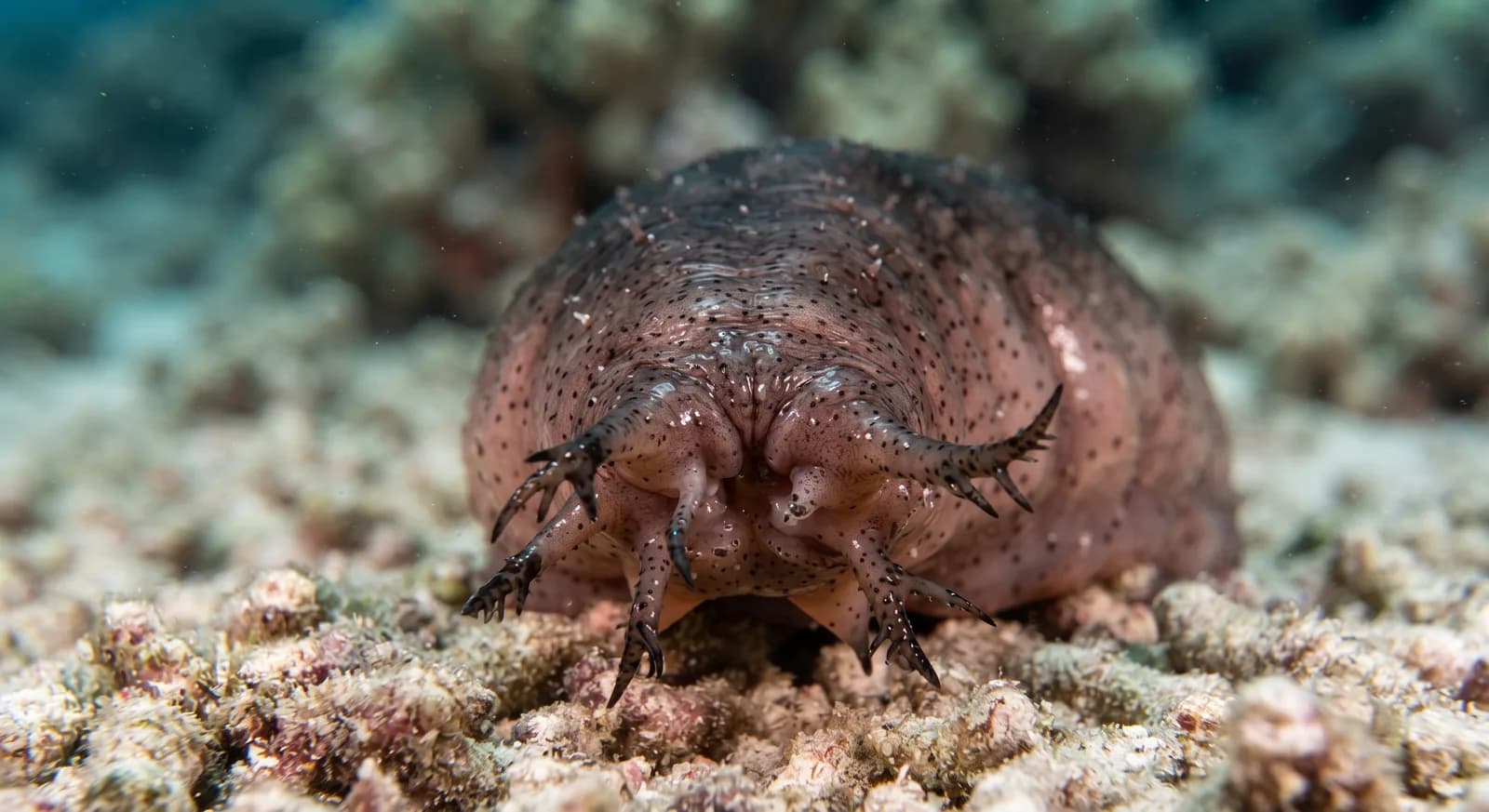
Pinkfish (Holothuria edulis)

Sea cucumbers · Holothuriida · Holothuriidae

Pinkfish

Holothuria edulis

Least Concern

The species is abundant and widely distributed; it faces no significant short-term risk.

Spotted something wrong?

Holothuria edulis, commonly known as the edible sea cucumber or the pink and black sea cucumber, is an echinoderm of the family Holothuriidae. Pearson placed it in the subgenus Halodeima in 1914, so that its full scientific name is Holothuria (Halodeima) edulis. It is found in the shallow waters of the tropical Indo-Pacific.

Size

20 cm – 40 cm

Diet

Omnivore

Combines animal and plant food depending on availability.

Activity

Nocturnal

Active mainly at night.

Social structure

Colony

Lives in large concentrations, often for breeding reasons.

Ocean
61countries2same family

AI-generated images: illustrations, not photographs.

Fun facts

  • By processing tonnes of sediment a year, sea cucumbers aerate and clean the reef floor and lower its local acidity, a service that favours coral growth.
  • Under attack it can expel part of its internal organs through the anus — sticky and sometimes toxic — and regrow them within weeks.
  • It is one of the species traded as trepang or bêche-de-mer, and the enormous Asian demand has depleted its populations across much of the Indo-Pacific.
  • It swallows sand and expels it stripped of organic matter. That work, multiplied by millions of individuals, is a real ecosystem service: sea cucumbers turn over and oxygenate the reef sediment and locally counteract acidification, because in digesting the carbonate they release alkalinity.
  • It defends itself by evisceration: it expels part of its internal organs through the cloaca, leaving them behind as a distraction, and regenerates them within weeks.
  • And sometimes it expels Cuvierian tubules, sticky filaments that entangle the aggressor.
  • Its name, edulis, alludes to its use: it is eaten dried as bêche-de-mer or trepang, above all on the Chinese market.
  • That demand has depleted sea cucumber populations across the whole Indo-Pacific, and several species of the genus are threatened; many countries have closed or restricted the fishery.
  • It frequently hosts an awkward lodger: the pearlfish, which lives inside its cloaca.

Life cycle and biology

Skeleton type
Invertebrate - endoskeleton of calcareous plates (echinoderm)
Habitat and environment
Sandy and rubble reef bottoms of the Indo-Pacific, from 0 to 30 m

Sources consulted: Wikipedia (es): Holothuria edulis

Where to find it

Loading map…

Related species

Other species in the catalogue with the most in common with Pinkfish — same habitat, park, country, tags or family.

Same taxonomic family
Related to
Related to
Related to
Related to

Keep exploring

Based on what we already know about pinkfish.

Share an experience, a fun fact or a tip for seeing the pinkfish.
See full glossary
This page in other languages: Español · Deutsch · Français · Português · Italiano
See its range on the interactive map→
Not Evaluated

Cotton-Spinner

Holothuria tubulosa

Endangered

Golden Sandfish

Holothuria scabra

European Storm-PetrelLeast Concern

European Storm-Petrel

Hydrobates pelagicus

Banded HumbugLeast Concern

Banded Humbug

Dascyllus aruanus

Least Concern

Raccoon Butterflyfish

Chaetodon lunula

Green CrabLeast Concern

Green Crab

Carcinus maenas

CountriesAmerican Samoa
TagsOmnivore
Omnivore
Nocturnal
Colonial
Ocean
Echinoderm

Asia26

Oceania20

Africa15

American Samoa
Australia
Bahrain
Bangladesh
Brunei
Cambodia
Bahrain
Bangladesh
Brunei
Cambodia
China
India
Indonesia
Iran
Japan
Kuwait
Malaysia
Maldives
Myanmar
Oman
Pakistan
Philippines
Qatar
Saudi Arabia
Singapore
Sri Lanka
Taiwan
Thailand
Timor-Leste
United Arab Emirates
Vietnam
Yemen
American Samoa
Australia
Cook Islands
Fiji
French Polynesia
Guam
Kiribati
Marshall Islands
Micronesia
Nauru
New Caledonia
Niue
Northern Mariana Islands
Palau
Papua New Guinea
Samoa
Solomon Islands
Tonga
Tuvalu
Vanuatu
Comoros
Djibouti
Egypt
Eritrea
Kenya
Madagascar
Mauritius
Mayotte
Mozambique
Réunion
Seychelles
Somalia
South Africa
Sudan
Tanzania