Skip to content
WAnimals
  • Map
  • Species
  • Parks
  • Diving
Log inCreate account
WAnimals

The guide for travellers and animal lovers: discover, plan and share your wild adventures around the world.

Discover wildlife

  • Species
  • Ecosystems
  • Glossary
  • Tags

Explore places

  • Map
  • Countries
  • Parks
  • Diving

Plan experiences

  • Guides

Learn

  • Blog

Resources

  • Help centre
  • Contact
  • Install the app

Follow us

Account

  • Log in
  • Create account

© 2026 WAnimals. All rights reserved.

About usHow we build our profilesTerms of servicePrivacyLegal notice
MapSpeciesParksDiving
  1. Home
  2. Species
  3. Codling Moth

One of the 4 moths on WAnimals
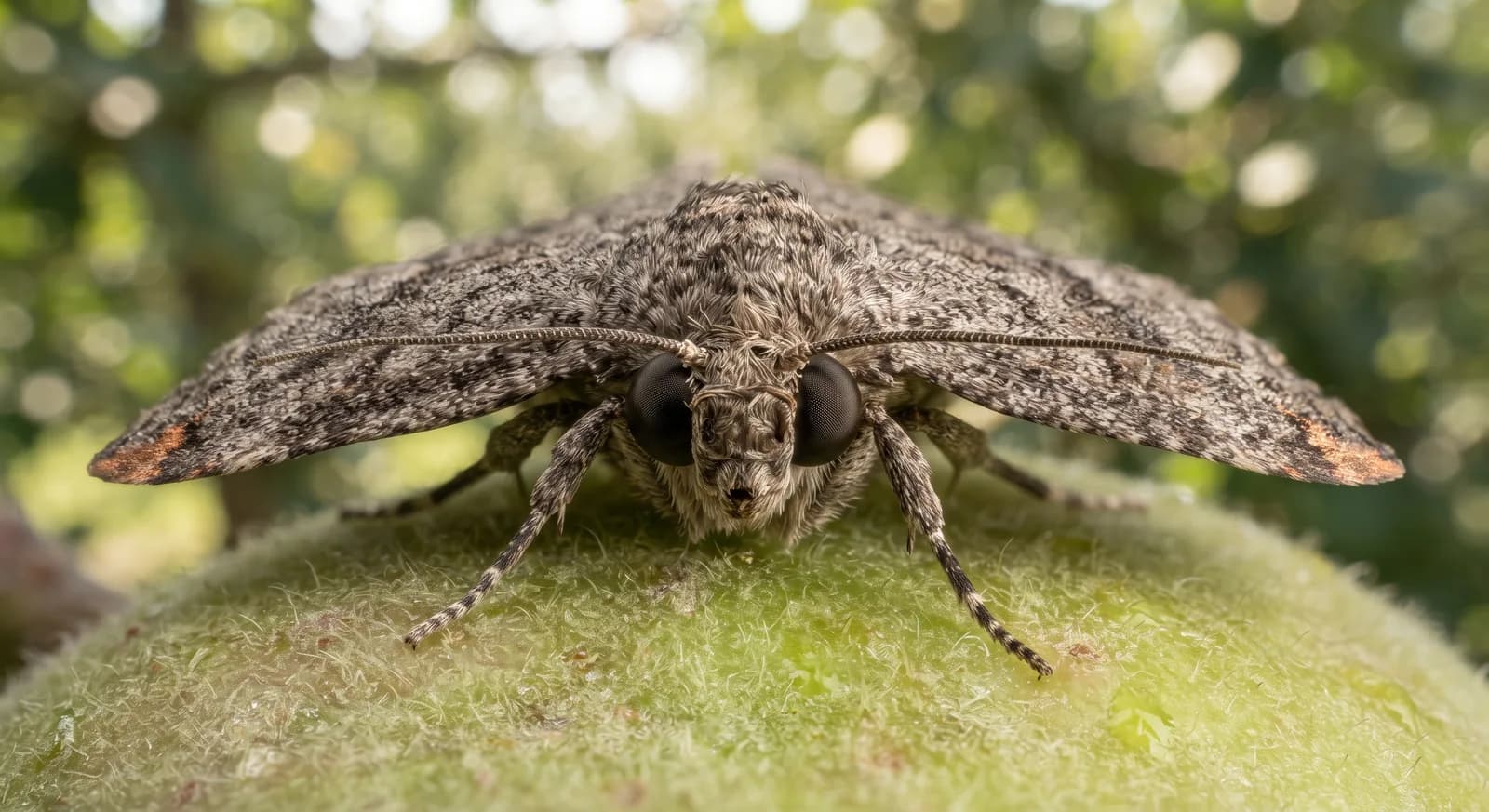
Codling Moth (Cydia pomonella)

Insects · Lepidoptera · Tortricidae

Codling Moth

Cydia pomonella

Not Evaluated

It has not yet been assessed against the IUCN criteria.

Spotted something wrong?

The codling moth is a ditrysian lepidopteran of the family Tortricidae. They are well known in agriculture, since their larvae are the familiar worms found in apples. Native to Europe, it was introduced into North America, where it became a common pest of apple trees, and has since spread worldwide. It also attacks pear, plum and other fruit trees. Its larva is the popular "apple worm".

Size

1.4 cm – 2.2 cm

Life expectancy

1 year

Diet

Herbivore

Feeds mainly on plants.
Activity

Nocturnal

Active mainly at night.

Social structure

Solitary

Lives and hunts alone, joining others only to breed.

Sighting difficulty

Unknown

Grassland
55countries

AI-generated images: illustrations, not photographs.

Fun facts

  • Modern control rests on mating disruption: the air is saturated with synthetic female pheromone and the males cannot find the females, a technique that has hugely cut insecticide use in fruit growing.
  • It is also fought with a granulosis virus specific to the species, harmless to any other organism.
  • The exit hole and the damp frass on the surface of the fruit are the sign that the larva has already left: by the time the hole shows, the apple has been occupied for some while.
  • This is the worm in the apple. The caterpillar bores into the fruit shortly after hatching, feeds on the flesh and the seeds, and exits through a hole, leaving a trail of droppings.
  • It is the most important pest of apple and pear in the temperate world, and it also attacks walnut and quince.
  • Its control is a case study: it is fought with mating disruption, dispersing synthetic pheromone through the orchard so that males cannot find the females, a technique that has greatly reduced insecticide use.
  • And it has been a pioneer in biological control with viruses: a specific granulovirus is used, harmless to everything else, which kills the caterpillars.
  • It has developed resistance to numerous insecticides and also, in some populations, to the granulovirus itself.
  • It overwinters as a caterpillar in a cocoon under the bark or in the soil, and pupates in spring.

Life cycle and biology

Skeleton type
Invertebrate - chitin exoskeleton (insect)
Habitat and environment
Apple, pear and walnut trees worldwide
Size at birth
Lens-shaped flattened egg 1.3 by 1.0 mm, opalescent with a red ring during development; the larva measures about 2 mm at birth and 13-19 mm when grown
Sexual maturity
The adults rest camouflaged on the bark during the day and become active at nightfall if the temperature rises above 10-15 °C; one to four generations a year depending on the climate
Gestation / incubation
The eggs hatch between 5 and 20 days depending on the temperature; the larva goes through five instars in 3-5 weeks inside the fruit
Litter / clutch size
50 to 100 eggs per female, laid one by one on the developing fruit or on nearby leaves and shoots

Sources consulted: https://es.wikipedia.org/wiki/Cydia_pomonella; IRAC, ficha Cydia pomonella; Cornell CALS; Eurasian Tortricidae, ficha Cydia pomonella; IRAC; NCBI PMC3629207, tolerancia al frio de Cydia pomonella; Eurasian Tortricidae

Where to find it

Best time: The first flight coincides with the end of apple blossom; the last generation overwinters as a larva under the bark or in the leaf litter

Loading map…

Related species

Other species in the catalogue with the most in common with Codling Moth — same habitat, park, country, tags or family.

Related to
Related to
Related to
Related to
Related to
Related to

Keep exploring

Based on what we already know about codling moth.

Comments

Share an experience, a fun fact or a tip for seeing the codling moth.

Be the first to comment.

See full glossary
This page in other languages: Español · Deutsch · Français · Português · Italiano
See its range on the interactive map→
Bare-nosed WombatLeast Concern

Bare-nosed Wombat

Vombatus ursinus

Near Threatened

Southern Hairy-nosed Wombat

Lasiorhinus latifrons

Least Concern

Ord's Kangaroo Rat

Dipodomys ordii

European HareLeast Concern

European Hare

Lepus europaeus

Common CockchaferNot Evaluated

Common Cockchafer

Melolontha melolontha

SwallowtailLeast Concern

Swallowtail

Papilio machaon

CountriesAlbania
TagsHerbivore
Herbivore
Nocturnal
Solitary
Insect
Grassland

Europe37

Asia7

South America4

North America3

Africa2

Oceania2

Albania
Argentina
Australia
Austria
Belarus
Belgium
Albania
Austria
Belarus
Belgium
Bosnia and Herzegovina
Bulgaria
Croatia
Cyprus
Czechia
Denmark
Estonia
Finland
France
Germany
Greece
Hungary
Ireland
Italy
Latvia
Lithuania
Luxembourg
Malta
Moldova
Montenegro
Netherlands
Norway
Poland
Portugal
Romania
Serbia
Slovakia
Slovenia
Spain
Sweden
Switzerland
Ukraine
United Kingdom
China
India
Iran
Israel
Japan
Russia
Türkiye
Argentina
Brazil
Chile
Uruguay
Canada
Mexico
United States
Morocco
South Africa
Australia
New Zealand