Skip to content
WAnimals
  • Map
  • Species
  • Parks
  • Diving
Log inCreate account
WAnimals

The guide for travellers and animal lovers: discover, plan and share your wild adventures around the world.

Discover wildlife

  • Species
  • Ecosystems
  • Glossary
  • Tags

Explore places

  • Map
  • Countries
  • Parks
  • Diving

Plan experiences

  • Guides

Learn

  • Blog

Resources

  • Help centre
  • Contact
  • Install the app

Follow us

Account

  • Log in
  • Create account

© 2026 WAnimals. All rights reserved.

About usHow we build our profilesTerms of servicePrivacyLegal notice
MapSpeciesParksDiving
  1. Home
  2. Species
  3. European Flesh Fly

One of the 15 flies on WAnimals
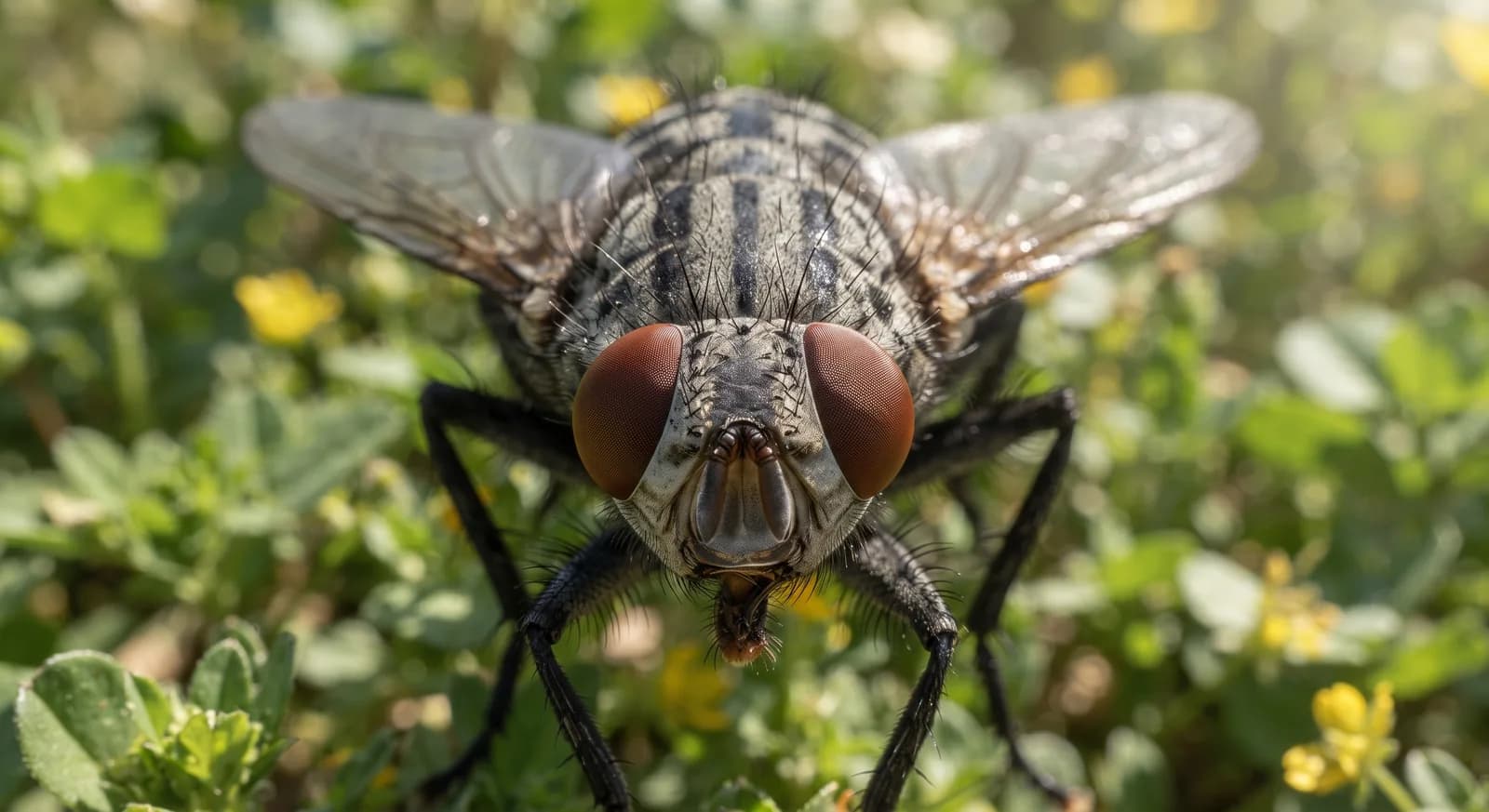
European Flesh Fly (Sarcophaga carnaria)

Insects · Diptera · Sarcophagidae

European Flesh Fly

Sarcophaga carnaria

Not Evaluated

It has not yet been assessed against the IUCN criteria.

Spotted something wrong?

A flesh fly, large and robust, grey with a black-striped thorax and an abdomen chequered in light and dark patches that shift with the angle of the light. Its eyes are red and its larvae develop in carrion and decaying organic matter.

Size

1 cm – 1.6 cm

Life expectancy

1 year

Diet

Carnivore

Feeds mainly on other animals.
Activity

Diurnal

Active mainly during the day.

Social structure

Solitary

Lives and hunts alone, joining others only to breed.

Sighting difficulty

Unknown

Grassland
54countries

AI-generated images: illustrations, not photographs.

Fun facts

  • It does not lay eggs: it is larviparous, depositing already-hatched larvae straight onto the carrion, which gives it a head start of hours over the flies that lay eggs.
  • In forensic entomology that trait is useful, because its presence and stage of development allow the time elapsed since death to be narrowed down.
  • The chequerboard on the abdomen is not a fixed pigment: it shifts in tone according to the observer's position, an effect of microstructures in the cuticle.
  • It does not lay eggs: it gives birth to live larvae. The eggs hatch inside the female and she deposits first-instar larvae directly onto the substrate, which gives them an advantage over the flies that lay eggs.
  • That strategy lets it arrive late at a carcass and still compete, because its larvae start off several hours ahead.
  • It is a key species in forensic entomology: the succession of species that colonise a corpse, and the developmental stage of their larvae, make it possible to estimate the post-mortem interval, and the sarcophagids are a regular part of that sequence.
  • It can be identified by the thorax with three longitudinal black bands and the abdomen with a grey-and-black chequerboard that shifts in tone with the angle of the light.
  • Identification to species level within the genus is very difficult and usually requires examination of the male genitalia, a real problem for forensic application.

Life cycle and biology

Skeleton type
Invertebrate - chitin exoskeleton (insect)
Habitat and environment
Rural and urban areas of Europe, around carrion and dung
Sexual maturity
The adults are powerful fliers and among the first to reach a corpse, sometimes within minutes of death
Gestation / incubation
The eggs hatch inside the female's uterus; the larvae feed for about four days and go through three instars before pupating; the cycle from larviposition to adult can be completed in two weeks
Litter / clutch size
A larviparous species: the female retains the eggs in a two-lobed uterine pouch and deposits live first-instar larvae; within the family 30 to 200 larvae per female are reported

Sources consulted: Universidad de Florida, Featured Creatures; Amendt et al. (2011), Forensic Entomology; Natural History Museum de Londres; ScienceDirect, ficha Sarcophaga; ficha de la familia Sarcophagidae; Fichas de biologia de Sarcophagidae; Ficha de especie de Sarcophaga carnaria

Where to find it

Best time: The adults come to decaying meat and droppings; the larvae of this species, unlike most of the genus, feed mainly on earthworms

Loading map…

Related species

Other species in the catalogue with the most in common with European Flesh Fly — same habitat, park, country, tags or family.

Related to
Related to
Related to
Related to
Related to
Related to

Keep exploring

Based on what we already know about european flesh fly.

Comments

Share an experience, a fun fact or a tip for seeing the european flesh fly.

Be the first to comment.

See full glossary
This page in other languages: Español · Deutsch · Français · Português · Italiano
See its range on the interactive map→
Common BuzzardLeast Concern

Common Buzzard

Buteo buteo

Eurasian HoopoeLeast Concern

Eurasian Hoopoe

Upupa epops

Common KestrelLeast Concern

Common Kestrel

Falco tinnunculus

Sacred ScarabNot Evaluated

Sacred Scarab

Scarabaeus sacer

Seven-spotted Lady BeetleNot Evaluated

Seven-spotted Lady Beetle

Coccinella septempunctata

Golden Ground BeetleLeast Concern

Golden Ground Beetle

Carabus auratus

CountriesAlbania
TagsCarnivore
Carnivore
Diurnal
Solitary
Insect
Grassland

Europe41

Asia10

Africa3

Albania
Algeria
Andorra
Armenia
Austria
Azerbaijan
Albania
Andorra
Austria
Belarus
Belgium
Bosnia and Herzegovina
Bulgaria
Croatia
Cyprus
Czechia
Denmark
Estonia
Finland
France
Germany
Greece
Hungary
Ireland
Italy
Latvia
Liechtenstein
Lithuania
Luxembourg
Malta
Moldova
Monaco
Montenegro
Netherlands
North Macedonia
Norway
Poland
Portugal
Romania
Serbia
Slovakia
Slovenia
Spain
Sweden
Switzerland
Ukraine
United Kingdom
Armenia
Azerbaijan
Georgia
Iran
Israel
Kazakhstan
Lebanon
Russia
Syria
Türkiye
Algeria
Morocco
Tunisia