Skip to content
WAnimals
  • Map
  • Species
  • Parks
  • Diving
Log inCreate account
WAnimals

The guide for travellers and animal lovers: discover, plan and share your wild adventures around the world.

Discover wildlife

  • Species
  • Ecosystems
  • Glossary
  • Tags

Explore places

  • Map
  • Countries
  • Parks
  • Diving

Plan experiences

  • Guides

Learn

  • Blog

Resources

  • About us
  • How we build our profiles
  • Help centre
  • Contact
  • Install the app

Follow us

Account

  • Log in
  • Create account

© 2026 WAnimals. All rights reserved.

Terms of servicePrivacyCookiesLegal notice
MapSpeciesParksDiving
  1. Home
  2. Species
  3. Leopard Slug

One of the 4 slugs on WAnimals
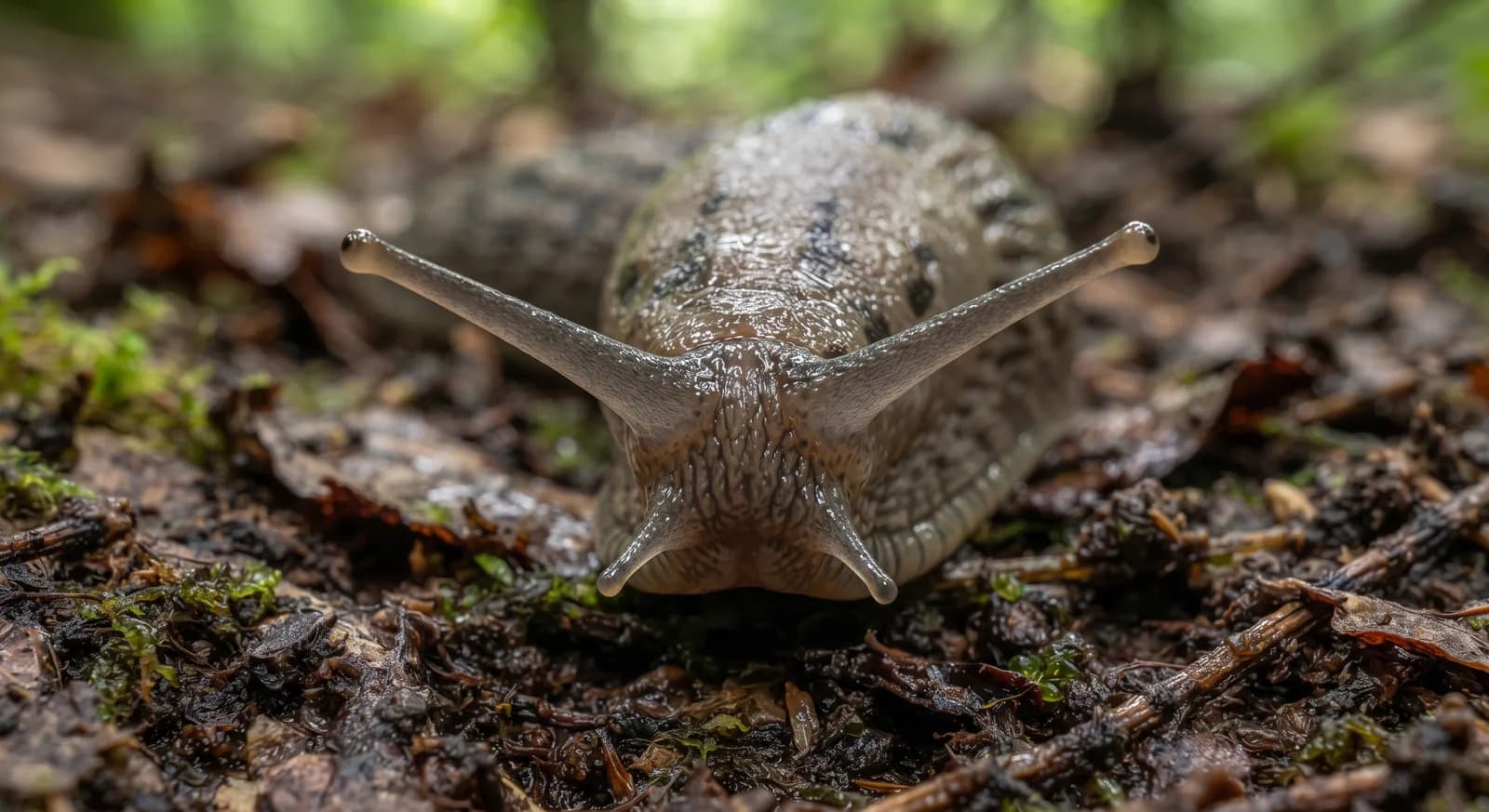
Leopard Slug (Limax maximus)

Gastropods · Pulmonata · Limacidae

Leopard Slug

Limax maximus

Least Concern

The species is abundant and widely distributed; it faces no significant short-term risk.

Spotted something wrong?

A large slug with a tapering body and a short keel along the rear third of the back. Over a pale brown, grey or yellowish ground it carries black mottling reminiscent of a leopard's coat; young animals have larger, more elongated spots. The mantle shield takes up a third of the body and is always spotted.

Size

10 cm – 20 cm

Life expectancy

3 years

Diet

Omnivore

Combines animal and plant food depending on availability.
Activity

Nocturnal

Active mainly at night.

Social structure

Solitary

Lives and hunts alone, joining others only to breed.

Temperate forest
61countries

AI-generated images: illustrations, not photographs.

Fun facts

  • Its mating is among the most spectacular in the animal world: the two animals hang in mid-air from a thread of mucus and unfurl bluish copulatory organs that twine around one another.
  • Beneath the mantle shield it keeps a vestigial internal shell of 13 to 15 mm, all that is left of the shell its lineage lost.
  • It is fast enough to hunt other slugs, and uses the previous night's slime trail to find its way back to its refuge and to the food it left half-eaten.
  • Its mating is among the most spectacular in the animal kingdom: the pair climbs a branch or a wall, lowers itself on a mucus thread of up to 40 cm and, hanging in mid-air, unfurls translucent, bluish copulatory organs that entwine in a spiral. The scene lasts for hours.
  • It is hermaphroditic, so both individuals exchange sperm in that same mating.
  • It is above all a scavenger and fungus-eater, not a herbivore: it eats fungi, rotting plant matter and other slugs, which is why it is not a serious garden pest, unlike the Spanish slug.
  • It is in fact a predator: it pursues and devours other slugs, including the harmful species.
  • It returns to its shelter each dawn by following its own mucus trail, and occupies the same hiding place for long periods.
  • Its slime trails on cellar walls are its most familiar sign.

Life cycle and biology

Skeleton type
Invertebrate - gastropod mollusc with no external shell (it retains a vestigial internal shell)
Habitat and environment
Highly varied, both natural and man-made: damp woodland, gardens, cellars and urban areas. Common across much of Europe including Corsica, Sardinia and the Balearics; scarcer in the south of the Iberian Peninsula. In Switzerland it reaches 1,900 m
Litter / clutch size
It is a cross-fertilising hermaphrodite. The pair mates hanging in the air from a thick thread of mucus suspended from a branch, intertwining their large white genital organs

Sources consulted: IUCN Red List · Asturnatura · Wikipedia (Limax maximus) · Botanical-online · El medi natural del Bages i del Moianès

Where to find it

Best time: Rainy nights and days; by day it stays hidden in its usual refuge

Loading map…

Related species

Other species in the catalogue with the most in common with Leopard Slug — same habitat, park, country, tags or family.

Related to
Related to
Related to
Related to
Related to
Related to

Keep exploring

Based on what we already know about leopard slug.

Share an experience, a fun fact or a tip for seeing the leopard slug.
See full glossary
This page in other languages: Español · Deutsch · Français · Português · Italiano
See its range on the interactive map→
Virginia OpossumLeast Concern

Virginia Opossum

Didelphis virginiana

Least Concern

Mexican Mouse Opossum

Marmosa mexicana

Southern Monito del MonteLeast Concern

Southern Monito del Monte

Dromiciops gliroides

Least Concern

Long-nosed Bandicoot

Perameles nasuta

Least Concern

Southern Brown Bandicoot

Isoodon obesulus

Least Concern

Common Brush-tailed Possum

Trichosurus vulpecula

CountriesAlbania
TagsOmnivore
Omnivore
Nocturnal
Solitary
Temperate forest
Mollusc

Europe41

Asia9

South America4

North America3

Africa2

Oceania2

Albania
Andorra
Argentina
Armenia
Australia
Austria
Albania
Andorra
Austria
Belarus
Belgium
Bosnia and Herzegovina
Bulgaria
Croatia
Czechia
Denmark
Estonia
Finland
France
Germany
Greece
Hungary
Iceland
Ireland
Italy
Kosovo
Latvia
Liechtenstein
Lithuania
Luxembourg
Moldova
Montenegro
Netherlands
North Macedonia
Norway
Poland
Portugal
Romania
San Marino
Serbia
Slovakia
Slovenia
Spain
Sweden
Switzerland
Ukraine
United Kingdom
Armenia
Azerbaijan
China
Georgia
Israel
Japan
Russia
South Korea
Türkiye
Argentina
Brazil
Chile
Uruguay
Canada
Mexico
United States
Morocco
South Africa
Australia
New Zealand