Birds · Falconiformes · Falconidae
Merlin
Falco columbarius
The species is abundant and widely distributed; it faces no significant short-term risk. See full glossary
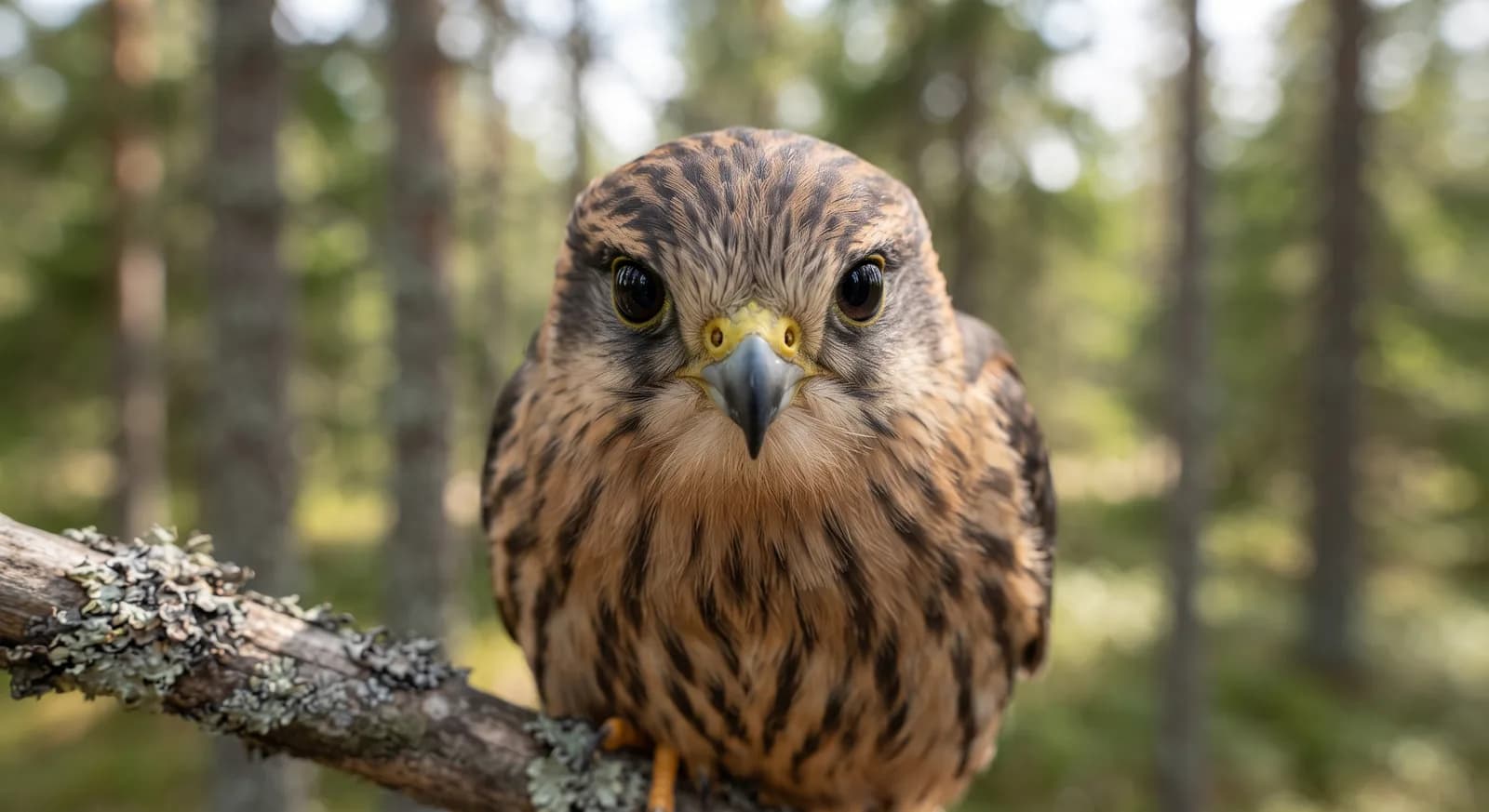
The smallest falcon in Europe, compact and low-flying, fast and acrobatic. The male is blue-grey above with a black band at the tip of the tail; the female, noticeably larger, is brown. Its silhouette recalls that of the common kestrel.
Weight
130 g – 280 g
Size
26 cm – 34 cm
Lifespan
15 years
Diet
Carnivore
Feeds mainly on other animals.
Activity
Diurnal
Active mainly during the day.
Social structure
In pairs
Usually lives in pairs, sometimes for life.
Sighting difficulty
Easy
Estimated population
The European breeding population is estimated at between 40,100 and 83,400 mature individuals according to the 2021 European Red List of Birds. In Spain, the wintering population has been estimated at a few thousand individuals
Fun facts
- alimentaciónIt is one of the smallest falcons in Europe, taking small birds in flight in fast, agile low-level chases.
- It builds no nest: it takes over abandoned nests of crows and other raptors, or scrapes a simple hollow in the heather.
- On its autumn migration it can cover more than 5,000 km from northern Europe to the south of the continent.
- First-year birds, especially males, sometimes act as 'nest helpers' to an adult pair.
Life cycle & biology
- Skeleton type
- Vertebrate - internal bony skeleton (bird)
- Habitat & environment
- Open, unobstructed country: cereal plains, moorland, sparsely vegetated steppe and marshy ground. It breeds in the taiga and tundra of northern Eurasia and North America
- Birth weight
- The chicks weigh about 13 g at hatching
- Gestation / incubation
- 28-32 days, mostly by the female while the male hunts. The chicks fledge about 30 days later and depend on their parents for another 4 weeks
- Litter / clutch size
- 3-5 pale buff eggs heavily speckled with reddish brown, laid between late April and early June
Sources consulted: SEO/BirdLife (ficha y III Atlas de las aves en época de reproducción en España); IUCN Red List; Asturnatura; Lista Roja Europea de Aves 2021; Warkentin et al. 2020, Birds of the World (Cornell Lab); Sunyer y Viñuela 1990, Ardeola 37; MITECO
Where to find it
See its range on the interactive mapBest time: From October to March in Spain, where it occurs only in winter
Where to watch it
Parques y spots de buceo donde se ha documentado esta especie — se muestran 10 de 52 documentados.
Related species
Other species in the catalogue with the most in common with Merlin — same habitat, park, country, tags or family.
Eurasian Hobby
Falco subbuteo
 Least Concern
Peregrine Falcon
Falco peregrinus
Eleonora's Falcon
Falco eleonorae
Lesser Kestrel
Falco naumanni
Red-footed Falcon
Falco vespertinus
Bat Falcon
Falco rufigularis
Keep exploring
Based on what we already know about merlin.
Comments
Share an experience, a fun fact or a tip for seeing the merlin.
Be the first to comment.