- Skeleton type
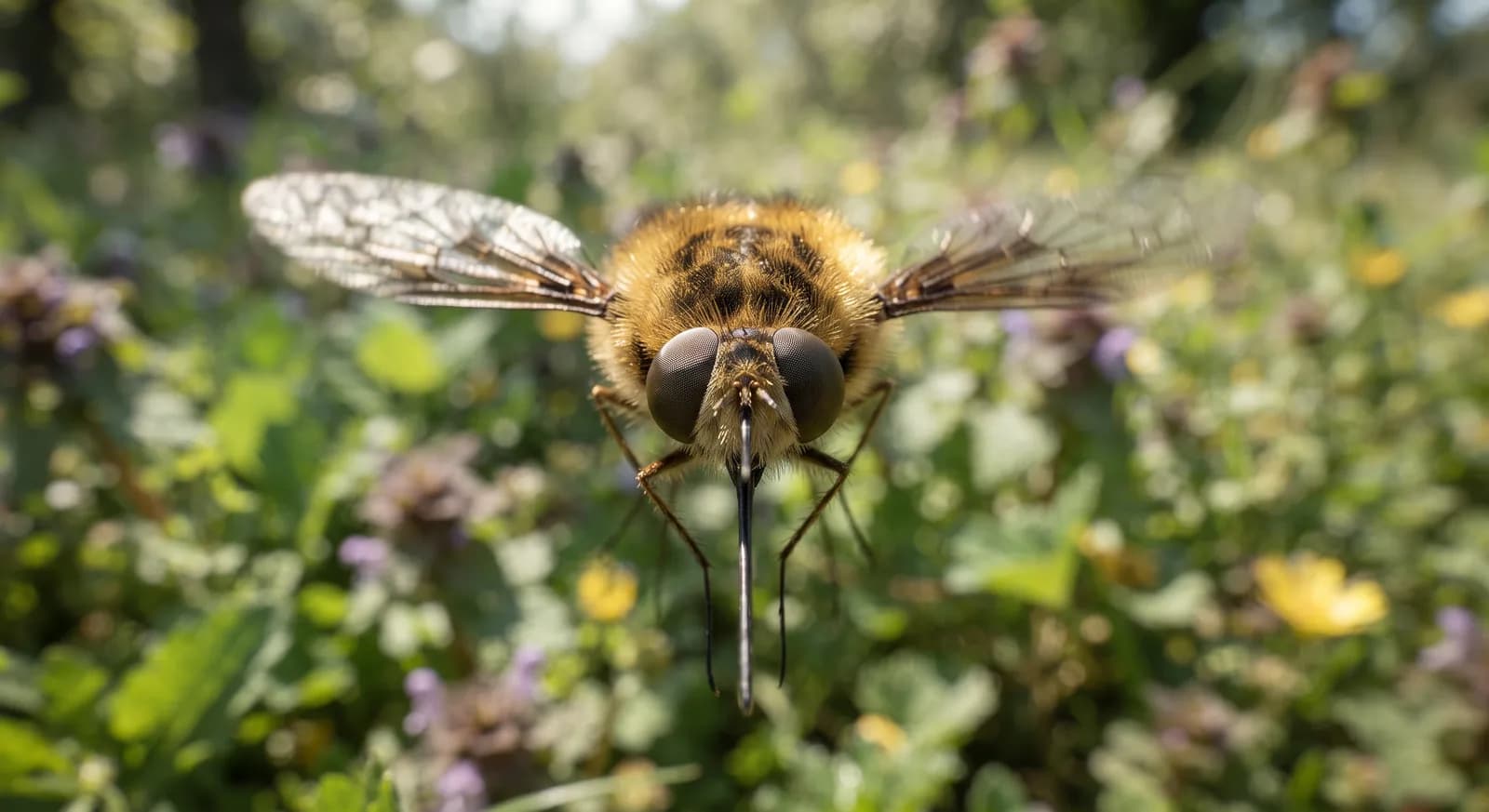
- Invertebrate - chitin exoskeleton (insect)
- Habitat and environment
- Forest edges, gardens and sunny banks with solitary bee nests
- Sexual maturity
- It shows hypermetamorphosis: the different larval instars have completely different forms, first a mobile larva that searches for the host and then a sedentary parasitic form
- Gestation / incubation
- The larva hatches inside the burrow, crawls to an open cell of the host and stays inactive until the bee larva is about to pupate; it then turns into an ectoparasite, attaches to it and sucks out its body fluids. The pupa can overwinter
- Litter / clutch size
- The female hovers over the entrance to the nest of a solitary mining bee, mainly of the genus Andrena, and flicks the eggs inside with a snap of the abdomen. She prefers groups of nests on a bank or slope, where the angle of fire is better
Sources consulted: Wikipedia (es): Bombylius major · Ficha de especie de Bombylius major (Boesi, Polidori & Andrietti) · UWM Field Station · NPS/iNaturalist, ficha Greater Bee Fly (Oldroyd 1964 · Stubbs & Drake 2001) · NPS/iNaturalist, ficha Greater Bee Fly (Stubbs & Drake 2001 · Paxton & Pohl 1999) · Recopilacion sobre Bombylius major · NPS/iNaturalist, ficha Greater Bee Fly · guias de la familia Bombyliidae · Ficha de especie de Bombylius major