Skip to content
WAnimals
  • Map
  • Species
  • Parks
  • Diving
Log inCreate account
WAnimals

The guide for travellers and animal lovers: discover, plan and share your wild adventures around the world.

Discover wildlife

  • Species
  • Ecosystems
  • Glossary
  • Tags

Explore places

  • Map
  • Countries
  • Parks
  • Diving

Plan experiences

  • Guides

Learn

  • Blog

Resources

  • About us
  • How we build our profiles
  • Help centre
  • Contact
  • Install the app

Follow us

Account

  • Log in
  • Create account

© 2026 WAnimals. All rights reserved.

Terms of servicePrivacyCookiesLegal notice
MapSpeciesParksDiving
  1. Home
  2. Species
  3. European Corn-borer
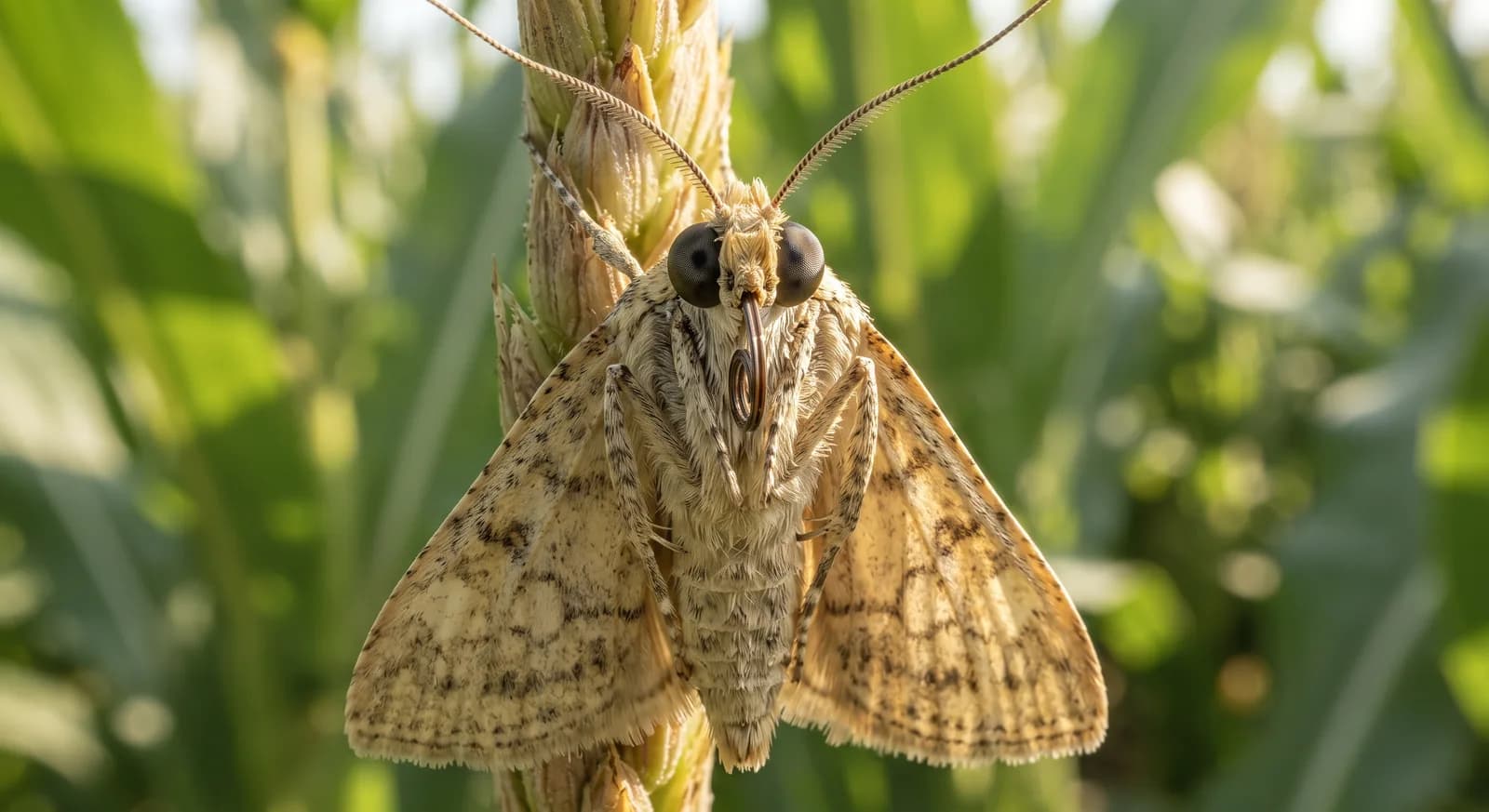
European Corn-borer (Ostrinia nubilalis)

Insects · Lepidoptera · Crambidae

European Corn-borer

Ostrinia nubilalis

Not Evaluated

It has not yet been assessed against the IUCN criteria.

Spotted something wrong?

The European corn borer is a pest of cereals, especially maize. It is native to Europe, where it originally infested varieties of millet. In North America it was first detected in 1917.

Size

2 cm – 3.4 cm

Diet

Herbivore

Feeds mainly on plants.

Activity

Nocturnal

Active mainly at night.
Social structure

Solitary

Lives and hunts alone, joining others only to breed.

Grassland
51countries

AI-generated images: illustrations, not photographs.

Fun facts

  • It is the pest against which the first transgenic Bt maize, which produces a bacterial insecticidal protein, was designed; its widespread planting in North America has cut populations so far that growers of conventional maize benefit too.
  • There are two races that use different pheromone blends and do not recognise one another, a much-studied case of speciation under way within a single species.
  • The larva overwinters inside the stems and crop residues, so shredding and ploughing in the stubble is a basic control measure.
  • It is the costliest maize pest of the temperate world: the caterpillar bores through the stalk from within, weakening it until it snaps, and it also attacks the cob.
  • It reached the United States around 1917, probably in millet brooms imported from Europe, and within a few decades it had colonised the entire Corn Belt.
  • It is the main reason Bt maize exists: the transgenic varieties that produce the Bacillus thuringiensis toxin were developed above all against this species.
  • And the result has been measured: a 2010 study calculated that Bt maize in the United States had generated some 6.9 billion dollars in accumulated benefit over fourteen years, and that most of it went to growers of conventional maize, because the reduction of the pest across the landscape benefited them too.
  • What is known as Ostrinia nubilalis is in fact two races, separated by the sex pheromone they use, that scarcely interbreed.

Life cycle and biology

Skeleton type
Invertebrate - chitin exoskeleton (insect)
Habitat and environment
Crops of maize, pepper and other thick-stemmed herbaceous plants
Size at birth
Egg 0.97 mm long by 0.74 mm wide; the mature larva reaches about 25 mm
Gestation / incubation
The eggs hatch in 4-9 days depending on the temperature; the larvae go through five or six instars in more than 30 days and the pupa lasts about 12 days
Litter / clutch size
500 to 600 eggs per female, in flat clutches of 15 to 30 on the underside of the leaves

Sources consulted: Wikipedia (es): Ostrinia nubilalis · Bugwoodwiki · NC State Extension · Bugwoodwiki, Ostrinia nubilalis · University of Illinois IPM · CABI, programas de control biologico en Canada · Clemson University Land-Grant Press · Colorado State University

Where to find it

Best time: It overwinters as a fifth-instar larva in the stems; it pupates when the mean temperature rises above 10 °C and the adults emerge about two weeks later, in late spring

Loading map…

Related species

Other species in the catalogue with the most in common with European Corn-borer — same habitat, park, country, tags or family.

Related to
Related to
Related to
Related to
Related to
Related to

Keep exploring

Based on what we already know about european corn-borer.

Share an experience, a fun fact or a tip for seeing the european corn-borer.
See full glossary
This page in other languages: Español · Deutsch · Français · Português · Italiano
See its range on the interactive map→
Least Concern

Ord's Kangaroo Rat

Dipodomys ordii

European HareLeast Concern

European Hare

Lepus europaeus

Common CockchaferNot Evaluated

Common Cockchafer

Melolontha melolontha

SwallowtailLeast Concern

Swallowtail

Papilio machaon

SilkwormNot Evaluated

Silkworm

Bombyx mori

Great Green Bush CricketNot Evaluated

Great Green Bush Cricket

Tettigonia viridissima

CountriesAlbania
TagsHerbivore
Herbivore
Nocturnal
Solitary
Insect
Grassland

Europe37

Asia7

Africa4

North America3

Albania
Algeria
Austria
Belarus
Belgium
Bosnia and Herzegovina
Albania
Austria
Belarus
Belgium
Bosnia and Herzegovina
Bulgaria
Croatia
Cyprus
Czechia
Denmark
Estonia
Finland
France
Germany
Greece
Hungary
Ireland
Italy
Latvia
Lithuania
Luxembourg
Malta
Moldova
Montenegro
Netherlands
Norway
Poland
Portugal
Romania
Serbia
Slovakia
Slovenia
Spain
Sweden
Switzerland
Ukraine
United Kingdom
China
Iran
Israel
Japan
Russia
South Korea
Türkiye
Algeria
Egypt
Morocco
Tunisia
Canada
Mexico
United States