Skip to content
WAnimals
  • Map
  • Species
  • Parks
  • Diving
Log inCreate account
WAnimals

The guide for travellers and animal lovers: discover, plan and share your wild adventures around the world.

Discover wildlife

  • Species
  • Ecosystems
  • Glossary
  • Tags

Explore places

  • Map
  • Countries
  • Parks
  • Diving

Plan experiences

  • Guides

Learn

  • Blog

Resources

  • About us
  • How we build our profiles
  • Help centre
  • Contact
  • Install the app

Follow us

Account

  • Log in
  • Create account

© 2026 WAnimals. All rights reserved.

Terms of servicePrivacyCookiesLegal notice
MapSpeciesParksDiving
  1. Home
  2. Species
  3. Spotted Eagle Ray
Spotted Eagle Ray (Aetobatus narinari)

Cartilaginous fish · Myliobatiformes · Myliobatidae

Spotted Eagle Ray

Aetobatus narinari

Endangered

At very high risk of extinction in the wild in the near future.

Spotted something wrong?

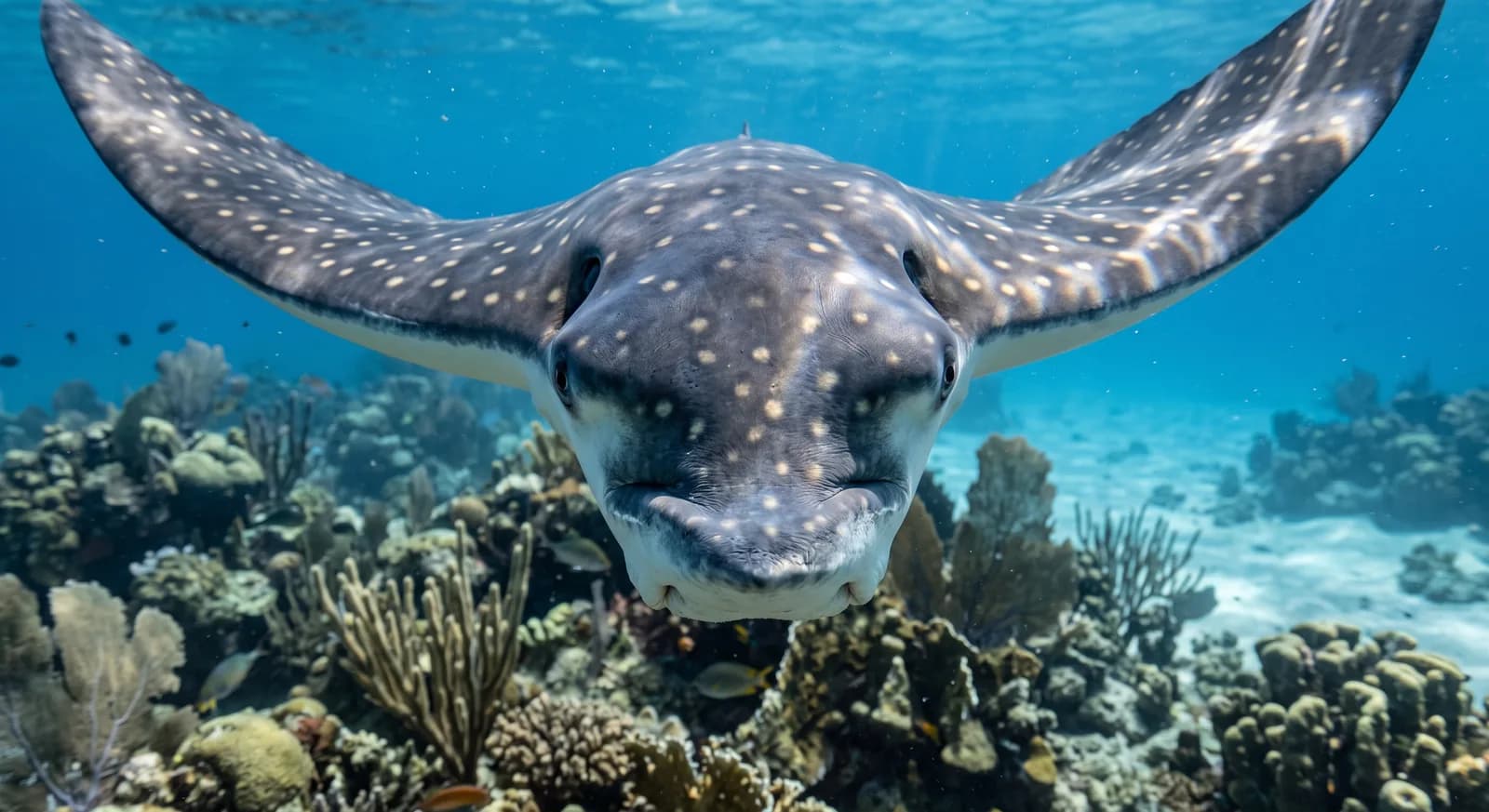
The spotted eagle ray — known in Venezuela as chucho pintado and in Ecuador as raya pintada — is a cartilaginous fish that lives in shallow coastal waters over coral reefs and in bays, at depths of up to 80 metres. Its tail is generally two to three times as long as its body and carries several venomous spines at the base.

Weight

50 kg – 230 kg

Size

1.5 m – 3.3 m

Life expectancy

25 years
Diet

Carnivore

Feeds mainly on other animals.

Activity

Diurnal

Active mainly during the day.

Social structure

Solitary

Lives and hunts alone, joining others only to breed.

Ocean
98countries69parks90dive sites1same family

AI-generated images: illustrations, not photographs.

Fun facts

  • comportamientoIt can leap clear of the water, and on rare occasions has been documented landing accidentally on boats.
  • It leaps clear of the water: full jumps several metres high have been documented, and the most widely accepted explanation is that they serve to shed parasites or to escape predators, although the behaviour is still debated.
  • Its snout works like a shovel: it digs into the sand in search of buried bivalves, which it crushes with flattened dental plates able to break thick shells.
  • The pattern of white spots is unique to each individual, like a fingerprint, and researchers use it to identify particular animals without having to tag them.

Life cycle and biology

Skeleton type
Vertebrate - cartilaginous skeleton (fish)
Habitat and environment
Reefs, bays, estuaries and tropical and subtropical coastal waters in every ocean
Birth weight
17-36 cm disc width at birth
Size at birth
17-36 cm disc width at birth; it is ovoviviparous
Sexual maturity
5 years
Gestation / incubation
12 months of gestation
Litter / clutch size
3 live young

Sources consulted: Wikipedia (es): Aetobatus narinari

Where to find it

Best time: All year round in shallow tropical waters; in the Caribbean and the Indo-Pacific it is often seen over sandy bottoms and in mangrove channels.

Loading map…

Where to see it

Parks and dive sites where this species has been documented — showing 20 of 159.

Related species

Other species in the catalogue with the most in common with Spotted Eagle Ray — same habitat, park, country, tags or family.

Shares a park
Shares a park
Shares a park
Shares a park
Shares a park
Shares a park

How to help

The spotted eagle ray is classified as endangered. Organisations such as the IUCN, WWF and the Wildlife Conservation Society work specifically on its conservation and that of its habitat; looking into their programmes is a good starting point if you want to get involved.

It's documented in 18 protected areas — one reason why protecting these places matters for its conservation.

Keep exploring

Based on what we already know about spotted eagle ray.

Share an experience, a fun fact or a tip for seeing the spotted eagle ray.
See full glossary
This page in other languages: Español · Deutsch · Français · Português · Italiano

The pins mark the parks and dive sites where its presence is documented.

See its range on the interactive map→
KomodoIndonesia
EvergladesUnited States
Sian Ka'anMexico
Revillagigedo ArchipelagoMexico
Cocos IslandCosta Rica
CoibaPanama
Bacalar ChicoBelize
GuanicaPuerto Rico
JaraguaDominican Republic
Tobago Main RidgeTrinidad and Tobago
Great Blue HoleBelize
Half Moon Caye WallBelize
Turneffe AtollBelize
Palancar ReefMexico
Isla Mujeres (whale shark)Mexico
Bloody Bay WallCayman Islands
USS Kittiwake wreckCayman Islands
Stingray CityCayman Islands
Tiger BeachBahamas
Jardines de la ReinaCuba
See all 69 parks
See all 90 dive sites
Whale SharkEndangered

Whale Shark

Rhincodon typus

Giant MantaEndangered

Giant Manta

Mobula birostris

Caribbean Reef SharkEndangered

Caribbean Reef Shark

Carcharhinus perezi

Green TurtleEndangered

Green Turtle

Chelonia mydas

Vulnerable

Diamondback Terrapin

Malaclemys terrapin

Bull SharkNear Threatened

Bull Shark

Carcharhinus leucas

CountriesMexico
ParksKomodoIndonesia
TagsCarnivore
Carnivore
Diurnal
Solitary
Endangered
Fish
Ocean

Africa27

Asia24

North America23

Oceania16

South America8

Mexico
United States
Belize
Cayman Islands
Colombia
Bahamas
Angola
Cabo Verde
Cameroon
Comoros
Côte d’Ivoire
Djibouti
Egypt
Eritrea
Gabon
Gambia
Ghana
Guinea
Kenya
Liberia
Madagascar
Mauritius
Mayotte
Mozambique
Namibia
Nigeria
Réunion
Seychelles
Sierra Leone
Somalia
South Africa
Sudan
Tanzania
Bangladesh
Brunei
Cambodia
China
India
Indonesia
Iran
Japan
Malaysia
Maldives
Myanmar
Oman
Pakistan
Philippines
Saudi Arabia
Singapore
South Korea
Sri Lanka
Taiwan
Thailand
Timor-Leste
United Arab Emirates
Vietnam
Yemen
Aruba
Bahamas
Barbados
Belize
Bermuda
Canada
Cayman Islands
Costa Rica
Cuba
Curaçao
Dominican Republic
Guadeloupe
Haiti
Honduras
Jamaica
Martinique
Mexico
Nicaragua
Panama
Puerto Rico
Saint Lucia
Trinidad and Tobago
United States
Australia
Fiji
French Polynesia
Guam
Kiribati
Marshall Islands
Micronesia
New Caledonia
New Zealand
Northern Mariana Islands
Palau
Papua New Guinea
Samoa
Solomon Islands
Tonga
Vanuatu
Argentina
Brazil
Colombia
French Guiana
Guyana
Suriname
Uruguay
Venezuela