Skip to content
WAnimals
  • Map
  • Species
  • Parks
  • Diving
Log inCreate account
WAnimals

The guide for travellers and animal lovers: discover, plan and share your wild adventures around the world.

Discover wildlife

  • Species
  • Ecosystems
  • Glossary
  • Tags

Explore places

  • Map
  • Countries
  • Parks
  • Diving

Plan experiences

  • Guides

Learn

  • Blog

Resources

  • Help centre
  • Contact
  • Install the app

Follow us

Account

  • Log in
  • Create account

© 2026 WAnimals. All rights reserved.

About usHow we build our profilesTerms of servicePrivacyLegal notice
MapSpeciesParksDiving
  1. Home
  2. Species
  3. Giant African Snail

Giant African Snail (Lissachatina fulica)

Gastropods · Stylommatophora · Achatinidae

Giant African Snail

Lissachatina fulica

Not Evaluated

It has not yet been assessed against the IUCN criteria.

Spotted something wrong?

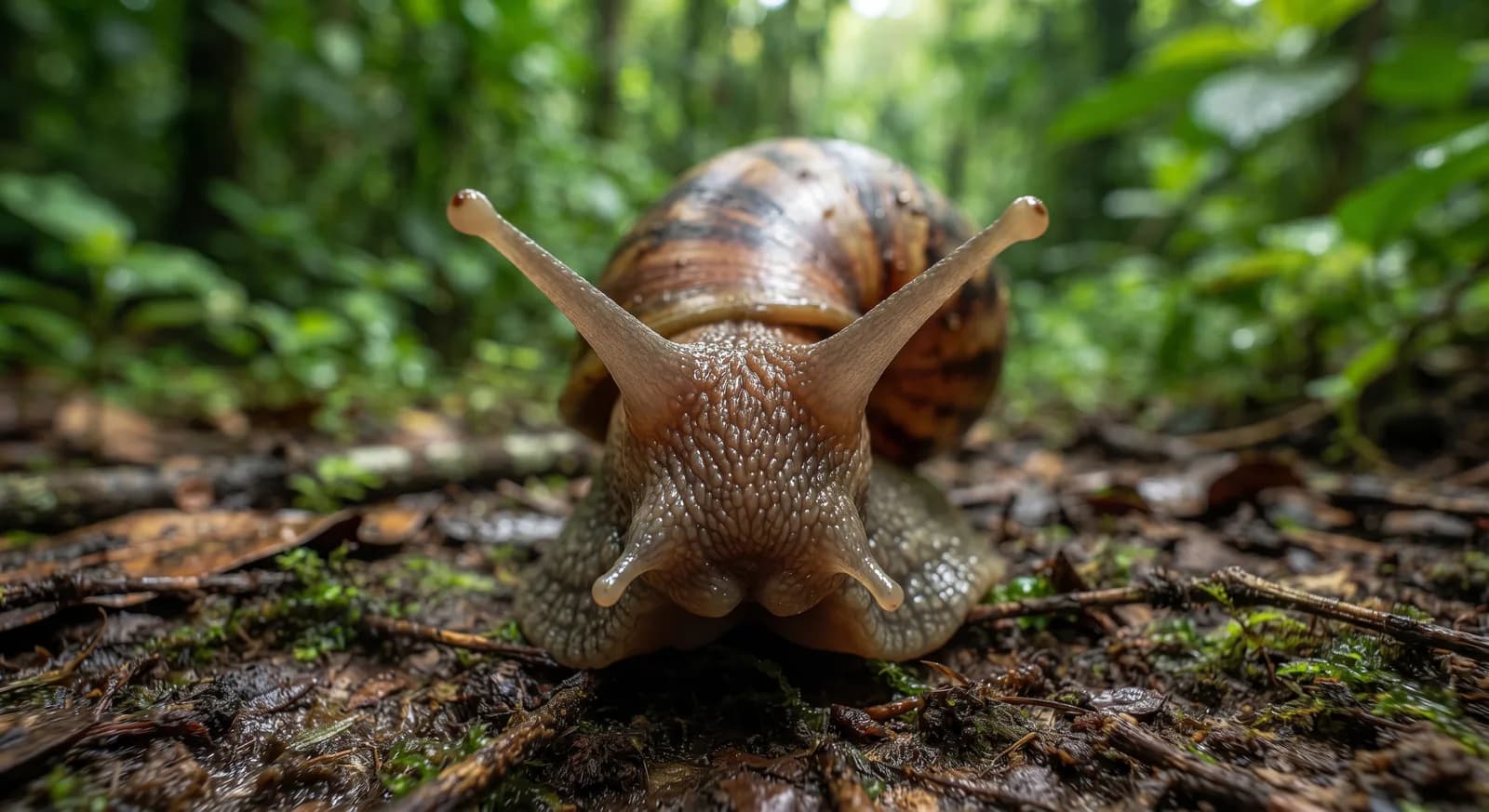
The giant African snail is a land snail of the family Achatinidae, in the order Stylommatophora. These snails are frequently found in gardens and crops, where they feed on various plants, sometimes becoming pests of economic importance.

Size

5 cm – 20 cm

Life expectancy

6 years

Diet

Herbivore

Feeds mainly on plants.
Activity

Nocturnal

Active mainly at night.

Social structure

Solitary

Lives and hunts alone, joining others only to breed.

Sighting difficulty

Unknown

Rainforest
106countries51parks

AI-generated images: illustrations, not photographs.

Fun facts

  • It is on the IUCN list of the 100 most damaging invasive alien species in the world.
  • It is hermaphroditic: two individuals fertilise each other and both lay eggs, and a single pair can produce hundreds of offspring in a year.
  • It can transmit the nematode Angiostrongylus cantonensis, which causes eosinophilic meningitis in humans, so it should not be handled without washing your hands afterwards.
  • In the dry season it seals the shell opening with a sheet of hardened mucus and goes dormant.
  • It appears on the IUCN list of the hundred worst invasive species in the world.
  • It eats almost anything: it prefers decomposing vegetation, lichens and fungi, but it has been recorded on hundreds of plant species, and masses of snails can raze an entire seedbed in a single night.
  • Its health risk is the most serious part: it is an intermediate host of the nematode Angiostrongylus cantonensis, the rat lungworm, which causes eosinophilic meningitis in people. Infection comes from eating raw or undercooked snails, or vegetables contaminated with their slime.
  • It was almost always introduced on purpose: as food, as a pet, for educational purposes or for rearing. It is a textbook case of invasion by the deliberate route.
  • Its size helps explain the problem: its shell reaches 20 cm and it lays several hundred eggs per clutch, with several clutches a year.
  • It is a hermaphrodite, and a single individual is enough to found a population if it has already been fertilised.
  • Florida managed to eradicate it twice, most recently with the lifting of the quarantine in 2021 after years of campaigning; it is one of the few successful eradications of an invasive mollusc.

Life cycle and biology

Skeleton type
Invertebrate - external calcareous shell (mollusc)
Habitat and environment
Humid tropical areas: crops, gardens and forest edges
Sexual maturity
5-8 months
Gestation / incubation
11-15 days
Litter / clutch size
100-400 eggs per clutch, with several clutches a year
Life expectancy in captivity
Up to 9 years

Sources consulted: https://es.wikipedia.org/wiki/Lissachatina_fulica

Where to find it

Loading map…

Where to see it

Parks and dive sites where this species has been documented — showing 10 of 51.

Related species

Other species in the catalogue with the most in common with Giant African Snail — same habitat, park, country, tags or family.

Shares a park
Shares a park
Shares a park
Shares a park
Shares a park
Shares a park

Keep exploring

Based on what we already know about giant african snail.

Comments

Share an experience, a fun fact or a tip for seeing the giant african snail.

Be the first to comment.

One of the 11 snails on WAnimals
See full glossary
This page in other languages: Español · Deutsch · Français · Português · Italiano

The pins mark the parks where its presence is documented.

See its range on the interactive map→
Serengeti National ParkTanzania
Maasai Mara National ReserveKenya
EvergladesUnited States
Hawaii VolcanoesUnited States
Fernando de NoronhaBrazil
NgorongoroTanzania
AmboseliKenya
TsavoKenya
Lake NakuruKenya
ComoeCôte d’Ivoire
See all 51 parks
Least Concern

Brown-throated Sloth

Bradypus variegatus

Least Concern

Sunda Flying Lemur

Galeopterus variegatus

Least Concern

Brazilian Porcupine

Coendou prehensilis

Pygmy HippopotamusEndangered

Pygmy Hippopotamus

Choeropsis liberiensis

Not Evaluated

Hercules Beetle

Dynastes hercules

Not Evaluated

Atlas Moth

Attacus atlas

CountriesTanzania
ParksSerengeti National ParkTanzania
TagsHerbivore
Herbivore
Nocturnal
Solitary
Rainforest
Mollusc

Africa49

North America18

Asia17

Oceania13

South America8

Europe1

Tanzania
Kenya
Uganda
United States
Brazil
Côte d’Ivoire
Angola
Benin
Botswana
Burkina Faso
Burundi
Cameroon
Central African Republic
Chad
Comoros
Côte d’Ivoire
Democratic Republic of the Congo
Djibouti
Equatorial Guinea
Eritrea
Eswatini
Ethiopia
Gabon
Gambia
Ghana
Guinea
Guinea-Bissau
Kenya
Lesotho
Liberia
Madagascar
Malawi
Mali
Mauritania
Mauritius
Mozambique
Namibia
Niger
Nigeria
Republic of the Congo
Réunion
Rwanda
São Tomé and Príncipe
Senegal
Seychelles
Sierra Leone
Somalia
South Africa
South Sudan
Sudan
Tanzania
Togo
Uganda
Zambia
Zimbabwe
Barbados
Belize
Costa Rica
Cuba
Dominican Republic
Guadeloupe
Guatemala
Haiti
Honduras
Jamaica
Martinique
Mexico
Nicaragua
Panama
Puerto Rico
Saint Lucia
Trinidad and Tobago
United States
Bangladesh
Brunei
Cambodia
China
India
Indonesia
Japan
Laos
Malaysia
Myanmar
Nepal
Philippines
Singapore
Sri Lanka
Taiwan
Thailand
Vietnam
Australia
Fiji
French Polynesia
Guam
Micronesia
New Caledonia
Northern Mariana Islands
Palau
Papua New Guinea
Samoa
Solomon Islands
Tonga
Vanuatu
Argentina
Bolivia
Brazil
Colombia
Ecuador
Paraguay
Peru
Venezuela
Spain