One of the 26 sharks on WAnimals
Cartilaginous fish · Hexanchiformes · Hexanchidae
Bluntnose Sixgill Shark
Hexanchus griseus
It could become endangered in the near future if current threats go unchecked. See full glossary
The bluntnose sixgill shark, known in Spanish as cañabota gris, is one of the most primitive large sharks alive: it retains six pairs of gills instead of the five of most modern sharks, a feature of its Jurassic ancestors. It can exceed five metres and makes daily vertical migrations of hundreds of metres.
Weight
200 kg – 600 kg
Size
3 m – 5.5 m
Lifespan
80 years
Diet
Carnivore
Feeds mainly on other animals.
Activity
Nocturnal
Active mainly at night.
Social structure
Solitary
Lives and hunts alone, joining others only to breed.
Sighting difficulty
Moderate
Fun facts
- anatomíaIt keeps a more primitive number of gill slits than most living sharks — six rather than the usual five — a trait it shares with some very ancient lineages.
- It retains six pairs of gills instead of five, a feature it shares with the sharks of the Jurassic and that places it among the oldest lineages of living sharks.
- It rises and falls hundreds of metres every day: it spends the day in the darkness of submarine canyons and climbs at night into shallower water to hunt.
- It is one of the longest-lived and slowest-breeding large sharks: it does not mature until it is past twenty, which makes it extremely vulnerable to deep-sea fishing.
Life cycle & biology
- Skeleton type
- Vertebrate - cartilaginous skeleton (fish)
- Habitat & environment
- Continental slopes and submarine canyons of every ocean, between 200 and 2,500 metres
- Sexual maturity
- 25 years
- Gestation / incubation
- More than 12 months of gestation
- Litter / clutch size
- 70 live young
Sources consulted: https://es.wikipedia.org/wiki/Hexanchus_griseus
Where to find it
See its range on the interactive mapWhere to watch it
Parques y spots de buceo donde se ha documentado esta especie — se muestran 20 de 69 documentados.
Related species
Other species in the catalogue with the most in common with Bluntnose Sixgill Shark — same habitat, park, country, tags or family.
 Near Threatened
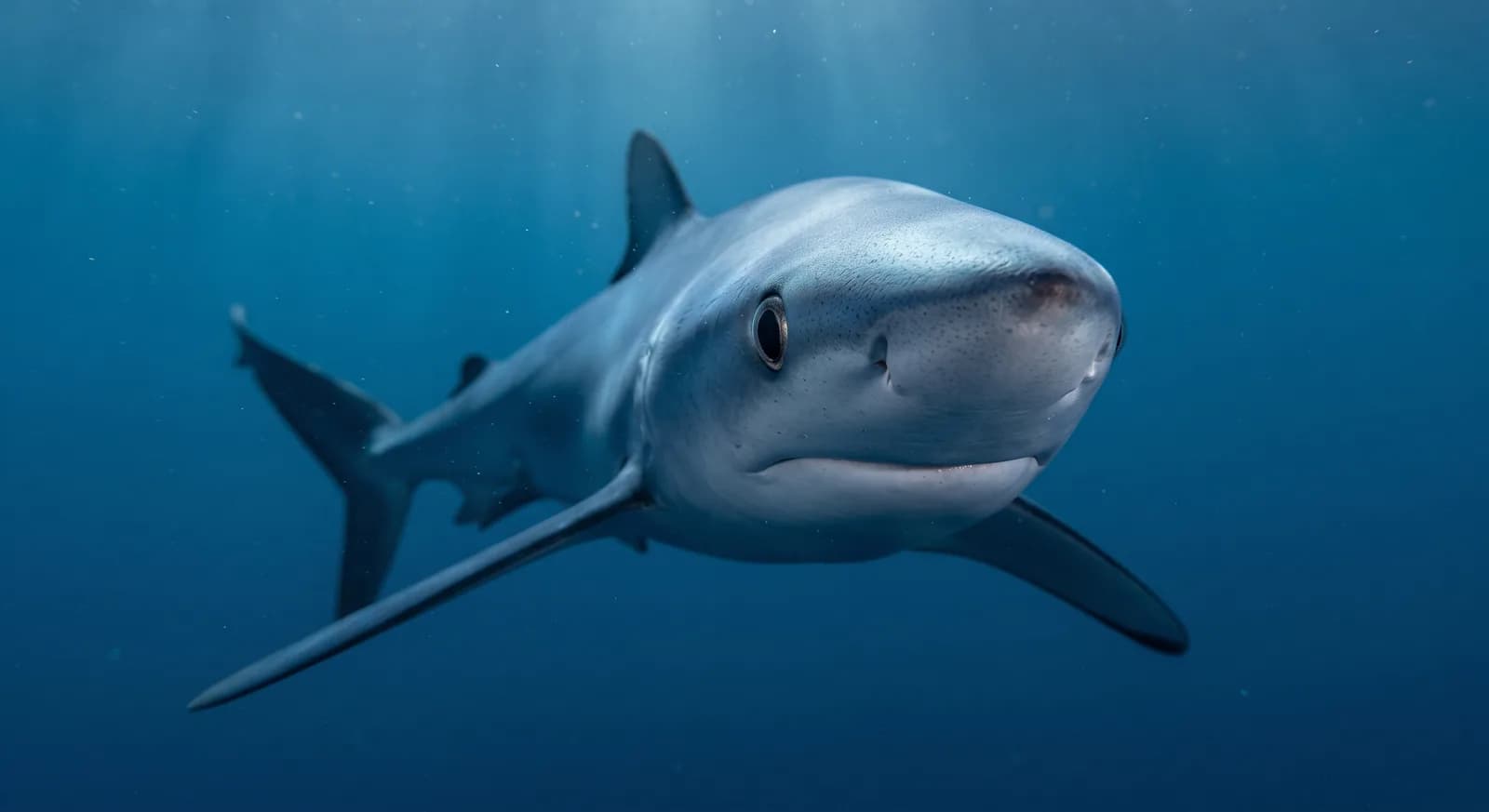
Blue Shark
Prionace glauca
Thornback Ray
Raja clavata
Common Stingray
Dasyatis pastinaca
Sea Bass
Dicentrarchus labrax
Swordfish
Xiphias gladius
Edible Sea Urchin
Echinus esculentus
Keep exploring
Based on what we already know about bluntnose sixgill shark.
Comments
Share an experience, a fun fact or a tip for seeing the bluntnose sixgill shark.
Be the first to comment.