Skip to content
WAnimals
  • Map
  • Species
  • Parks
  • Diving
Log inCreate account
WAnimals

The guide for travellers and animal lovers: discover, plan and share your wild adventures around the world.

Discover wildlife

  • Species
  • Ecosystems
  • Glossary
  • Tags

Explore places

  • Map
  • Countries
  • Parks
  • Diving

Plan experiences

  • Guides

Learn

  • Blog

Resources

  • Help centre
  • Contact
  • Install the app

Follow us

Account

  • Log in
  • Create account

© 2026 WAnimals. All rights reserved.

About usHow we build our profilesTerms of servicePrivacyLegal notice
MapSpeciesParksDiving
  1. Pram Bug

Malacostracans · Amphipoda · Hyperiidae

Pram Bug

Phronima sedentaria

Not Evaluated

It has not yet been assessed against the IUCN criteria.

Spotted something wrong?

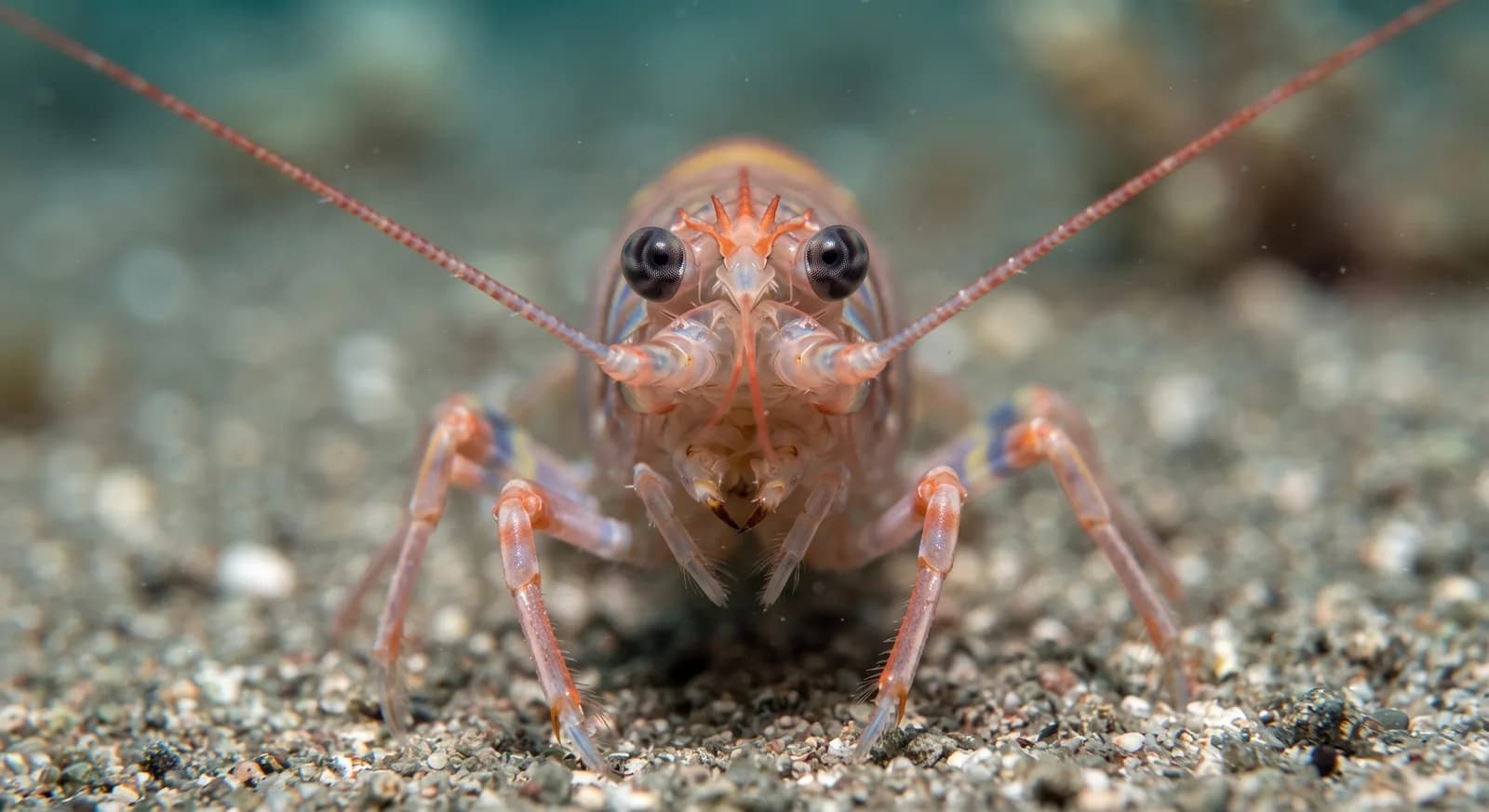
A transparent pelagic amphipod with enormous eyes that lives in the open sea in almost every ocean. The female attacks salps and other gelatinous tunicates, devours their insides and keeps the empty tunic as a transparent barrel in which she settles, propelling it with her legs and raising her young inside it.

Size

1 cm – 4.2 cm

Diet

Carnivore

Feeds mainly on other animals.

Social structure

Solitary

Lives and hunts alone, joining others only to breed.

Sighting difficulty

Unknown

Ocean
161countries61parks

Fun facts

  • The female does not make her house: she builds it by hollowing out the body of a living tunicate and then living inside the transparent husk.
  • She places her young on the inner wall of the barrel and keeps them there until they can swim on their own.
  • Its eyes take up almost the whole head and are divided into two pairs, one facing upwards and one forwards, adapted to the gloom of the deep ocean.
  • The female attacks a salp, a barrel-shaped gelatinous zooplankter, cuts out its brain, gills and stomach with her claws, eats them and leaves the tube hollow. Then she moves inside and uses it as a house.
  • Technically it is not a parasite but a parasitoid: it kills its host. But the barrel retains living cells, which keeps its structure intact.
  • Inside she lays hundreds of eggs, which line the walls; the young feed on what remains of the salp's tissue. Hence its common name, the pram bug.
  • It swims like a child with a float: it grips the barrel with its front legs and propels itself with the rear ones. The barrel also gives it buoyancy and works out cheaper than swimming free.
  • Its extraordinary double eyes, tuned to blue, have puzzled scientists for decades.
  • It is often cited as the inspiration for the xenomorph in the film Alien.

Life cycle and biology

Skeleton type
Invertebrate - articulated calcareous exoskeleton (crustacean)
Habitat and environment
Open water between 200 and 1,000 m, rising towards the surface at night
Litter / clutch size
Hundreds of eggs, laid inside the barrel

Sources consulted: MBARI; Smithsonian National Museum of Natural History (Osborn); Sardet (2015), Plankton

Where to find it

Loading map…

Where to see it

Parks and dive sites where this species has been documented — showing 10 of 61.

Related species

Other species in the catalogue with the most in common with Pram Bug — same habitat, park, country, tags or family.

Shares a park
Shares a park
Shares a park
Shares a park
Shares a park
Shares a park

Keep exploring

Based on what we already know about pram bug.

Comments

Share an experience, a fun fact or a tip for seeing the pram bug.

Be the first to comment.

Home
Species
See full glossary
This page in other languages: Español · Deutsch · Français · Português · Italiano

The pins mark the parks where its presence is documented.

See its range on the interactive map→
CalanquesFrance
Cinque TerreItaly
Alonissos and the Northern SporadesGreece
RedwoodUnited States
OlympicUnited States
Glacier BayUnited States
Channel IslandsUnited States
Pacific RimCanada
Gwaii HaanasCanada
Macquarie IslandAustralia
See all 61 parks
Not Evaluated

Edible Crab

Cancer pagurus

Common LobsterLeast Concern

Common Lobster

Homarus gammarus

American LobsterLeast Concern

American Lobster

Homarus americanus

Norway LobsterLeast Concern

Norway Lobster

Nephrops norvegicus

Great White SharkVulnerable

Great White Shark

Carcharodon carcharias

Harbor SealLeast Concern

Harbor Seal

Phoca vitulina

CountriesUnited States
ParksCalanquesFrance
TagsCarnivore
Carnivore
Solitary
Ocean
Crustacean

Africa40

North America34

Asia33

Europe22

Oceania21

South America11

United States
Italy
United Kingdom
Spain
France
Portugal
Algeria
Angola
Benin
Cabo Verde
Cameroon
Comoros
Côte d’Ivoire
Democratic Republic of the Congo
Djibouti
Egypt
Equatorial Guinea
Eritrea
Gabon
Gambia
Ghana
Guinea
Guinea-Bissau
Kenya
Liberia
Libya
Madagascar
Mauritania
Mauritius
Mayotte
Morocco
Mozambique
Namibia
Nigeria
Republic of the Congo
Réunion
São Tomé and Príncipe
Senegal
Seychelles
Sierra Leone
Somalia
South Africa
Sudan
Tanzania
Togo
Tunisia
Anguilla
Antigua and Barbuda
Aruba
Bahamas
Barbados
Belize
Bermuda
British Virgin Islands
Canada
Cayman Islands
Costa Rica
Cuba
Curaçao
Dominica
Dominican Republic
El Salvador
Grenada
Guadeloupe
Guatemala
Haiti
Honduras
Jamaica
Martinique
Mexico
Nicaragua
Panama
Puerto Rico
Saint Kitts and Nevis
Saint Lucia
Saint Vincent and Grenadines
Trinidad and Tobago
Turks and Caicos Islands
U.S. Virgin Islands
United States
Bahrain
Bangladesh
Brunei
Cambodia
China
India
Indonesia
Iran
Israel
Japan
Kuwait
Lebanon
Malaysia
Maldives
Myanmar
North Korea
Oman
Pakistan
Philippines
Qatar
Russia
Saudi Arabia
Singapore
South Korea
Sri Lanka
Syria
Taiwan
Thailand
Timor-Leste
Türkiye
United Arab Emirates
Vietnam
Yemen
Albania
Belgium
Bosnia and Herzegovina
Croatia
Cyprus
Denmark
France
Germany
Greece
Iceland
Ireland
Italy
Malta
Monaco
Montenegro
Netherlands
Norway
Portugal
Slovenia
Spain
Sweden
United Kingdom
American Samoa
Australia
Cook Islands
Fiji
French Polynesia
Guam
Kiribati
Marshall Islands
Micronesia
Nauru
New Caledonia
New Zealand
Niue
Northern Mariana Islands
Palau
Papua New Guinea
Samoa
Solomon Islands
Tonga
Tuvalu
Vanuatu
Argentina
Brazil
Chile
Colombia
Ecuador
French Guiana
Guyana
Peru
Suriname
Uruguay
Venezuela