Skip to content
WAnimals
  • Map
  • Species
  • Parks
  • Diving
Log inCreate account
WAnimals

The guide for travellers and animal lovers: discover, plan and share your wild adventures around the world.

Discover wildlife

  • Species
  • Ecosystems
  • Glossary
  • Tags

Explore places

  • Map
  • Countries
  • Parks
  • Diving

Plan experiences

  • Guides

Learn

  • Blog

Resources

  • About us
  • How we build our profiles
  • Help centre
  • Contact
  • Install the app

Follow us

Account

  • Log in
  • Create account

© 2026 WAnimals. All rights reserved.

Terms of servicePrivacyCookiesLegal notice
MapSpeciesParksDiving
  1. Atlantic Pyrosome
Atlantic Pyrosome (Pyrosoma atlanticum)

Thaliaceans · Pyrosomatida · Pyrosomatidae

Atlantic Pyrosome

Pyrosoma atlanticum

Not Evaluated

It has not yet been assessed against the IUCN criteria.

Spotted something wrong?

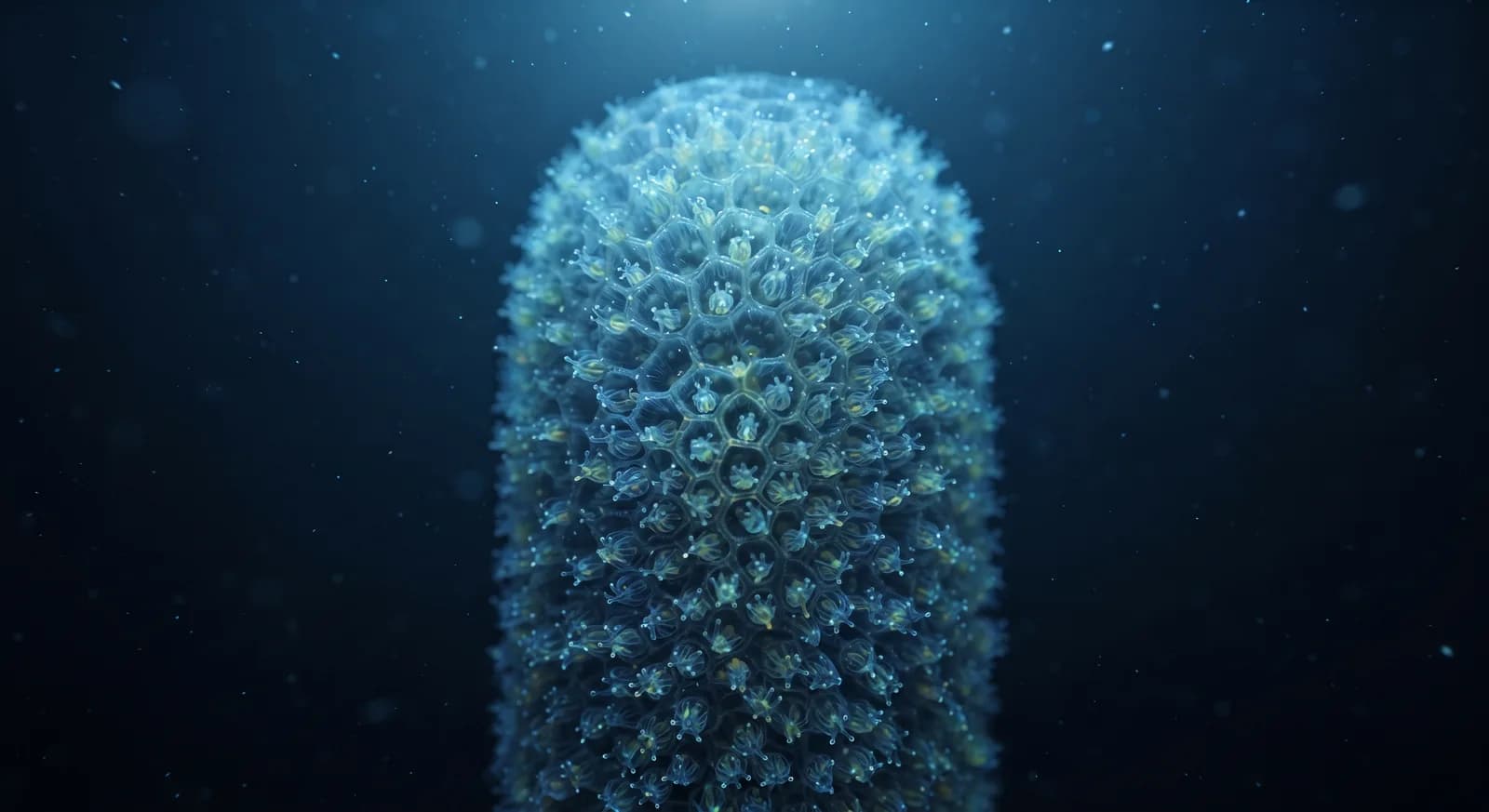
A pyrosome is a floating colony shaped like a gelatinous tube open at one end, made up of thousands of tiny individuals called zooids, all embedded in a common tunic. Each zooid filters water and expels it into the inside of the tube, so that the whole colony moves by jet propulsion.

Size

10 cm – 60 cm

Diet

Omnivore

Combines animal and plant food depending on availability.

Social structure

Colony

Lives in large concentrations, often for breeding reasons.
Ocean
161countries56parks108dive sites

AI-generated images: illustrations, not photographs.

Fun facts

  • GeneralA floating colony of thousands of individuals that glows an intense blue when touched.
  • Although it looks like a jellyfish, it is a tunicate — a distant relative of the vertebrates, and far closer to us than to the cnidarians.
  • It makes daily vertical migrations of hundreds of metres, and its dense, fast-sinking faecal pellets carry carbon from the surface to the ocean floor.
  • It is not one animal but a colony: thousands of individuals called zooids, each a few millimetres long, embedded in a common gelatinous tunic shaped like a hollow thimble open at one end.
  • It propels itself collectively. Each zooid filters water and expels it into the inside of the tube, and the sum of all those jets drives the whole colony forward.
  • It is intensely bioluminescent, hence its name, which means fire body. A flash in one zooid spreads through the whole colony in waves of blue-green light.
  • It filters phytoplankton with extraordinary efficiency, and its dense, fast-sinking faecal pellets carry carbon to the seabed: they are a recognised component of the biological carbon pump.
  • In 2017 there was a mass bloom off the west coast of North America that clogged fishing nets and covered beaches, a phenomenon without precedent in that area.

Life cycle and biology

Habitat and environment
Ocean waters from 0 to 800 m

Sources consulted: Péron (1804) · Sutherland et al. (2018), Journal of Plankton Research · Bowlby et al.

Where to find it

Loading map…

Where to see it

Parks and dive sites where this species has been documented — showing 20 of 164.

Related species

Other species in the catalogue with the most in common with Atlantic Pyrosome — same habitat, park, country, tags or family.

Shares a park
Shares a park
Shares a park
Shares a park
Shares a park
Shares a park

Keep exploring

Based on what we already know about atlantic pyrosome.

Share an experience, a fun fact or a tip for seeing the atlantic pyrosome.
Home
Species
See full glossary
This page in other languages: Español · Deutsch · Français · Português · Italiano

The pins mark the parks and dive sites where its presence is documented.

See its range on the interactive map→
Doñana National ParkSpain
CalanquesFrance
Cinque TerreItaly
Alonissos and the Northern SporadesGreece
RedwoodUnited States
OlympicUnited States
Glacier BayUnited States
Channel IslandsUnited States
Pacific RimCanada
Gwaii HaanasCanada
Channel Islands National ParkUnited States
La Jolla CoveUnited States
Julian Rocks (Byron Bay)Australia
Poor Knights IslandsNew Zealand
Fiordland (Milford Sound)New Zealand
Scapa FlowUnited Kingdom
Zenobia WreckCyprus
Medes IslandsSpain
Cap de CreusSpain
El Hierro / La RestingaSpain
See all 56 parks
See all 108 dive sites
Mediterranean MusselNot Evaluated

Mediterranean Mussel

Mytilus galloprovincialis

Not Evaluated

Chequered Carpet Shell

Ruditapes decussatus

Not Evaluated

Rosy Feather-star

Antedon bifida

Not Evaluated

Peacock Worm

Sabella pavonina

Common Spider CrabNot Evaluated

Common Spider Crab

Maja squinado

Not Evaluated

Mediterranean Hermit Crab

Clibanarius erythropus

CountriesSpain
ParksDoñana National ParkSpain
TagsOmnivore
Omnivore
Colonial
Ocean
Chordate

Africa40

North America34

Asia33

Europe22

Oceania21

South America11

Spain
Italy
United States
Greece
United Kingdom
Croatia
Algeria
Angola
Benin
Cabo Verde
Cameroon
Comoros
Côte d’Ivoire
Democratic Republic of the Congo
Djibouti
Egypt
Equatorial Guinea
Eritrea
Gabon
Gambia
Ghana
Guinea
Guinea-Bissau
Kenya
Liberia
Libya
Madagascar
Mauritania
Mauritius
Mayotte
Morocco
Mozambique
Namibia
Nigeria
Republic of the Congo
Réunion
São Tomé and Príncipe
Senegal
Seychelles
Sierra Leone
Somalia
South Africa
Sudan
Tanzania
Togo
Tunisia
Anguilla
Antigua and Barbuda
Aruba
Bahamas
Barbados
Belize
Bermuda
British Virgin Islands
Canada
Cayman Islands
Costa Rica
Cuba
Curaçao
Dominica
Dominican Republic
El Salvador
Grenada
Guadeloupe
Guatemala
Haiti
Honduras
Jamaica
Martinique
Mexico
Nicaragua
Panama
Puerto Rico
Saint Kitts and Nevis
Saint Lucia
Saint Vincent and the Grenadines
Trinidad and Tobago
Turks and Caicos Islands
U.S. Virgin Islands
United States
Bahrain
Bangladesh
Brunei
Cambodia
China
India
Indonesia
Iran
Israel
Japan
Kuwait
Lebanon
Malaysia
Maldives
Myanmar
North Korea
Oman
Pakistan
Philippines
Qatar
Russia
Saudi Arabia
Singapore
South Korea
Sri Lanka
Syria
Taiwan
Thailand
Timor-Leste
Türkiye
United Arab Emirates
Vietnam
Yemen
Albania
Belgium
Bosnia and Herzegovina
Croatia
Cyprus
Denmark
France
Germany
Greece
Iceland
Ireland
Italy
Malta
Monaco
Montenegro
Netherlands
Norway
Portugal
Slovenia
Spain
Sweden
United Kingdom
American Samoa
Australia
Cook Islands
Fiji
French Polynesia
Guam
Kiribati
Marshall Islands
Micronesia
Nauru
New Caledonia
New Zealand
Niue
Northern Mariana Islands
Palau
Papua New Guinea
Samoa
Solomon Islands
Tonga
Tuvalu
Vanuatu
Argentina
Brazil
Chile
Colombia
Ecuador
French Guiana
Guyana
Peru
Suriname
Uruguay
Venezuela